
 (No Ratings Yet)
 Loading...
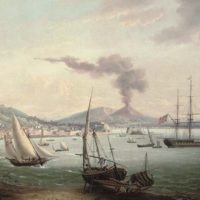 An English Frigate In The Bay Of Naples by John Thomas Serres
 Figures on a beach near Naples by Giovanni Serritelli
 View of Brussels from the NorthEast by Hercules Seghers
 Cattle watering in a River Landscape, believed to be Chile by Thomas Jacques Somerscales
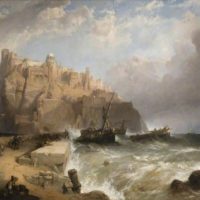 The Castle of Ischia by Clarkson Stanfield
 Landscape with Rocky Hills and Stream by William Louis Sonntag
 Landscape with Waterfall and Figures by William Louis Sonntag
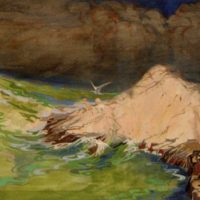 The Tale Of Kynon by George Sheringham
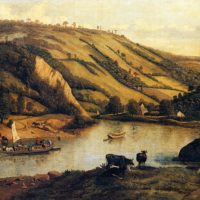 An Extensive River landscape, Probably Derbyshire, With Drovers And Their Cattle In The Foreground by Jan Siberechts
 Landscape with Rainbow, Henley-on-Thames by Jan Siberechts

 (6 votes, average: 3.50 out of 5)Loading...
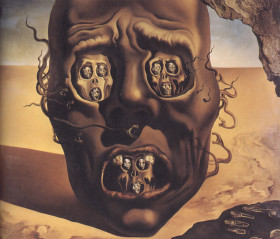
The Face of War is Spanish artist Salvador Dali’s attempt to impersonate war itself. It is depicted terrifying, unlikable and to some extent, scary. It was made in 1940 right after the end of the Spanish Civil War and before the beginning of the second World War. The Face of War Analysis The setting is of a desert at the time of late evening when the sun is still lingering near the horizon. The face is dismembered from its body and has withered to death. Though, there are expressions on it. Expressions which are left on a dead man’s face. It’s shock and misery. The face is in the awe by the happenings of a war. On the both sides, it is covered with alive […]
 (3 votes, average: 3.00 out of 5)Loading...
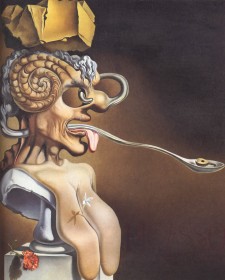
This is an ambivalent painting of cubist artist Pablo Picasso by the surrealist master Salvador Dali produced in the year of 1947. Portrait of Picasso Analysis The surrealist portrait painting of Pablo Picasso by Salvador Dali is infused with symbolic messages and meanings as Dali’s most famous works are. Basically, instead of a direct face, it is a portrait of Picasso’s bust sculpture. The base of the bust is made out of the regular white stone out of which most bust-sculptures are made of. But, the upper part is covered with skin. There is a white flower in the distorted chest of the bust, while a red one, is laying at the feet of the bust. The head is much more distorted than the chest […]
 (1 votes, average: 4.00 out of 5)Loading...
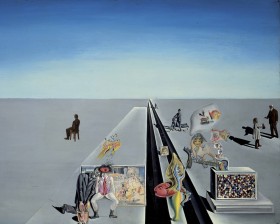
This is one of the earliest surrealist paintings from Salvador Dali. It was produced in 1929 when Dali was around 25 years old. He had completed his short experiments with Cubism and was getting allured towards the Surrealism which he expanded largely in his later life. The First Days of Spring Analysis There is a large, endless grey platform spreading on all sides visible in the scene. In the middle, the platform lowers itself two steps on the left side. Normal, natural, abnormal, unnatural, dreamy…all types of elements are put on this big plain in arbitrary manner. Some resembles to the real life natural objects, on the other some are very bizarre and somewhat nightmarish. For example, a feminine figure sitting on the lower left […]
 (3 votes, average: 3.67 out of 5)Loading...
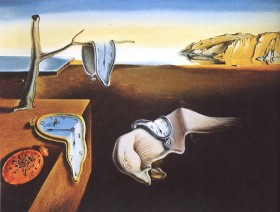
Dali’s paintings always forced us to interpret meanings out of the irrelevant things he put in his paintings. They were sometimes grotesque, sometimes beautiful, dreamy, alien or totally unrelated to the world. But, every painting made sense through Dali’s own symbolism which often represented a subject. Though, the subject could be a message or just a simple depiction of an intriguing muse or something which grabbed Dali’s attention. Melting Watches and Unreal Creature For many critics, The Persistence of Memory is a demonstration of a dream world. It includes all the elements a dream could have. Though, the title itself represents the painting as being a memory fading away after a long time. Or being distorted after considerable time period. Reason for critics to interpret […]
 (No Ratings Yet)Loading...
‘Sometimes, I spit for fun on my mother’s portrait.’ “The only difference between me and a madman is I’m not mad.” These are some quotes by this much-famed artist. It is very hard to believe on the second line after seeing the photographs. I mean, who would pose in front of camera like this when you know that you are a famous personality and will be seen everywhere. And what about the first quotation? Does it make any sense? Even after he said that ‘I am not strange, I am just not normal’, it will take some courage to consider him not strange after reading the full article. Imprisonment and his thoughts upon the scene Dali was born on 11th May 1904 in Figueres, Spain in […]


