
 (No Ratings Yet)
 Loading...
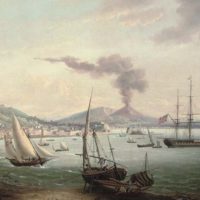 An English Frigate In The Bay Of Naples by John Thomas Serres
 Figures on a beach near Naples by Giovanni Serritelli
 View of Brussels from the NorthEast by Hercules Seghers
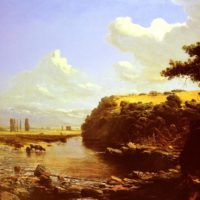 Cattle watering in a River Landscape, believed to be Chile by Thomas Jacques Somerscales
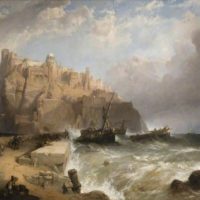 The Castle of Ischia by Clarkson Stanfield
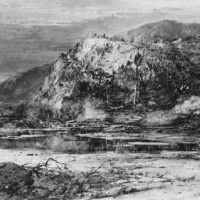 Landscape with Rocky Hills and Stream by William Louis Sonntag
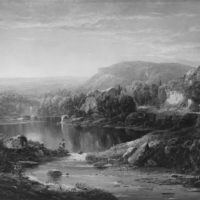 Landscape with Waterfall and Figures by William Louis Sonntag
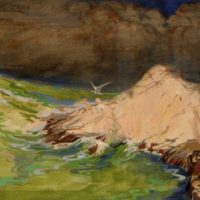 The Tale Of Kynon by George Sheringham
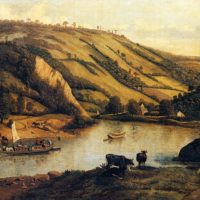 An Extensive River landscape, Probably Derbyshire, With Drovers And Their Cattle In The Foreground by Jan Siberechts
 Landscape with Rainbow, Henley-on-Thames by Jan Siberechts
Painting Hierarchy or the Hierarchy of Genres are the six main types of painting:
1. History Painting
2. Portrait Painting
3. Genre Painting
4. Landscape Painting
5. Animal Painting
6. Still Life Painting
Most of the paintings falls in one or more of these categories and are defined, interpreted accordingly.
 (No Ratings Yet)Loading...
This drawing is a folio of the Abrams Album (named after the donor) in the Fogg Art Museum, Harvard University, Cambridge, Massachusetts. Willem van Aelst’s drawing of a gorget and a backplate is an example of the supposedly Delft tradition of vanitas still-life.
 (No Ratings Yet)Loading...
The ostentatious display of killed animals after hunt had a representational and symbolic function. The motif of a dead animal hanging upside down – an actual hunting custom – had been taken over by 17th century Dutch painters from earlier artists such as Jacopo de’ Barbari and Lucas Cranach the Elder.
 (No Ratings Yet)Loading...
The picture depicts a still-life with peaches and grapes fallen from an over-turned basket, resting on a partly-draped marble ledge. The painting has been reduced from a vertical to horizontal format, resulting in the loss of the signature.
 (No Ratings Yet)Loading...
Willem van Aelst was a still-life specialist prized for his lovely flower and fruit pieces, and he has been mentioned as a sometime follower of Kalf. He also painted a number of elegant game pictures in a clear light. They show close views of dead prey – occasionally accompanied by killed poultry – that include scrupulously painted guns, hunting bags and horns, bells and other gear of the sport. As most trophy pieces they were designed as representative pictures of the sport, not records of the spoils of a specific hunt. In this picture the painter displayed the finely worked equipment of the huntsman on a marble ledge: a velvet hunting bag with chamois strap, trimmed with gold embroidery and fringes, and a tasseled horn. […]
 (No Ratings Yet)Loading...
In addition to fruit and flower still-lifes with cool colour harmonies, van Aelst also enjoyed painting elegant hunting weapons and dead animals placed in a dark corner by a wall for rich clients. One example is this still-life. A dead partridge is hanging by its leg from a piece of string. Its wings and feathers, which are grey with brownish patches, open up towards us at the bottom like a fan. The fly on the light-coloured feathers has an illusionist effect: disproportionately large in size, it belongs to the realistic level of the picture rather than its fictitious one, so that the viewer is given the impression that a real fly is crawling across the painting. The bird’s head has been pressed slightly towards the […]
(No Ratings Yet)Loading...The painting comes from Ghent’s Abbey of St Peter, where it hung over the fireplace in the kitchen. This monumental painting, with its realistically represented fish, shellfish and crustaceans, has a hidden moral message: distracted by the abundance of good things and their amorous thoughts, the principal figures fail to notice the cutpurse as he surreptitiously goes about his business.
 (No Ratings Yet)Loading...
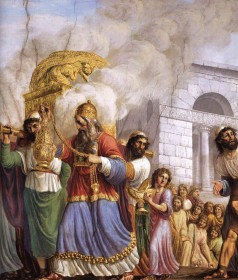
This scene is a detail of the fresco cycle in the Room of the Ark. Billowing clouds of aromatic incense surround the Ark of the Covenant, which is being carried in a solemn procession into the city of Jerusalem. The high priest of the Temple leads the pageant with the tabernacle containing the sacred Tablets of the Law.

