
 (No Ratings Yet)
 Loading...
 An English Frigate In The Bay Of Naples by John Thomas Serres
 Figures on a beach near Naples by Giovanni Serritelli
 View of Brussels from the NorthEast by Hercules Seghers
 Cattle watering in a River Landscape, believed to be Chile by Thomas Jacques Somerscales
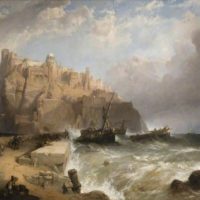 The Castle of Ischia by Clarkson Stanfield
 Landscape with Rocky Hills and Stream by William Louis Sonntag
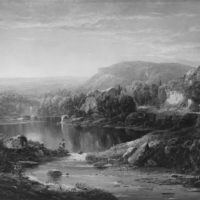 Landscape with Waterfall and Figures by William Louis Sonntag
 The Tale Of Kynon by George Sheringham
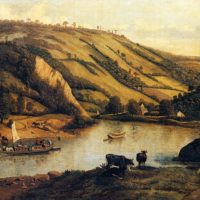 An Extensive River landscape, Probably Derbyshire, With Drovers And Their Cattle In The Foreground by Jan Siberechts
 Landscape with Rainbow, Henley-on-Thames by Jan Siberechts
Among the different types of paintings, Portrait Paintings are comprehensive ways to capture a man’s glory, disposition or social stance in one single moment. It is a style which quickly captures the viewer’s attention and gives a quick glimpse in the past of the depicted person or group. Portrait paintings stand strong among the other types of paintings.
According to Oxford Dictionary, “A painting, drawing, photograph, or engraving of a person, especially one depicting only the face or head and shoulders.”
Though, the last words of the definition aren’t the mandatory properties of a portrait as the type has grown into much more complex and various ways of depicting a person.
Portraits could represent a person, an artist or a group of people. They are just the simple depictions of people. Still, they aren’t just profiles of the persons. Sometimes, portraits could tell us more history about the contemporary times than a city’s landscape from the same era.
For instance, during the Dutch Golden age, people were afraid of expressing their pride through an extravagant portrait as it was considered bad during the time. Thus, the total of more than 1 million portraits from that time were mostly dull, expressionless and similar. You won’t get this information in the brilliant vista of a cityscape.
Even the most famous painting in the world is also a portrait. Other famous paintings like Girl with a Pearl Earring and American Gothic are also different types of portrait as you would know about them in detail at here.
Artists would generally have very limited space to include any significant object in the portrait as compared to a Landscape Painting or a Still Life Painting where he can add all the objects he could imagine. Thus, the included objects, scenes, background or other elements would be chosen very carefully to represent the accurate impression of the person or persons portrayed. Artist would care of the littlest details to represent the disposition or the concurrent impression of the person and would eliminate any redundant objects or implications. It is somewhat similar to still-life in which every included element generally holds some meaningful symbolism.
Thus, portraits could embody the person’s disposition, general impression, importance, significance, background, stance in society, history, a specific phase or the whole society’s outlook through a single representative person.
According to the subject, context or need of the artist, portrait paintings have developed many types to distinguish or signify different characteristics. Each type has been developed over the different centuries or ages and have matured in today’s portraits. This, findings and techniques of portrait paintings have significantly helped the portrait photography in modern times. You can find a mode called “portrait” in your phone’s camera. The term is derived from here, obviously.
If you haven’t read our post on the Different Types of Portraits, you can read about it on the given link.
(No Ratings Yet)Loading...It seems from this painting that Lucia was not less talented then her sister, Sofonisba.

 (1 votes, average: 2.00 out of 5)Loading...
In the painting the nun wears a lily-white habit which stands out against the dark background. The red and gold bound book of prayers offers the only source of detail. The sitter is usually identified as Elena Anguissola, Sofonisba’s younger sister who had been a student of the painter Bernardino Campi along with Sofonisba, and later entered the monastery of San Vincenzo in Mantua assuming the name of Sister Minerva.
(No Ratings Yet)Loading...It is assumed by some critics that the painting represents the artist herself, not her sister Minerva.
(No Ratings Yet)Loading...That women could be intellectually accomplished and highly rational, even strategic, are the complementary themes of a family portrait showing Anguissola’s three sisters playing chess. In this painting, which Vasari saw hanging in the artist’s family home in Cremona in 1566, the chivalric game of chess takes place in an idealized landscape familiar in late medieval courtly images of the game and not in a tavern or other questionable locale seen in other contemporary representations of gaming. On the far left Lucia looks out at the viewer, dominating our gaze as her arm and obvious expertise dominate the chess board. She has removed two of Minerva’s pieces from the game and the younger sister opens her mouth and raises her hand as if to speak. […]
(No Ratings Yet)Loading...One of the period’s most inventive portraitists came from Cremona. The noblewoman Sofonisba Anguissola created wry and witty portraits of family members and acquaintances, a subject largely imposed upon her by societal restrictions on female access to models and patrons. Sofonisba’s painting of her teacher, painting her portrait – a story within a story – demonstrates how she negotiated her male-dominated world. Anguissola’s gaze rivets the viewer of the painting, forcing consideration of what appears to be the inscribing of male authority on the body of the female. Campi’s gaze complicates matters, however, since as he paints he, too, looks out of the painting toward what the picture indicates must be his subject, Anguissola. Thus the viewer in front of the painting plays a double […]
 (No Ratings Yet)Loading...
D’Ancona moved to Paris in 1868, the year the composer of such famous operas like the Barber of Seville and Cinderella died. This posthumous portrait of Rossini, who spent several decades in the French capital where he was known for his sharp wit, appears to have been executed from a photograph, as its oval format may indicate. In the wave of renewed Italian nationalism, the painting may have been intended as a symbolic gesture to bring the Italian composer back to his native country.


