 (No Ratings Yet)
 Loading...
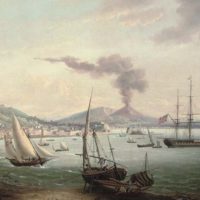 An English Frigate In The Bay Of Naples by John Thomas Serres
 Figures on a beach near Naples by Giovanni Serritelli
 View of Brussels from the NorthEast by Hercules Seghers
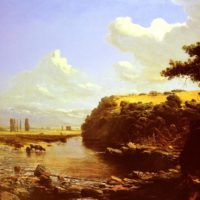 Cattle watering in a River Landscape, believed to be Chile by Thomas Jacques Somerscales
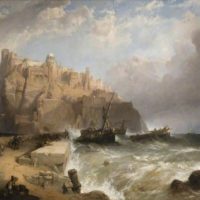 The Castle of Ischia by Clarkson Stanfield
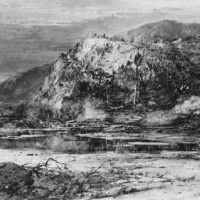 Landscape with Rocky Hills and Stream by William Louis Sonntag
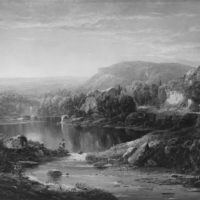 Landscape with Waterfall and Figures by William Louis Sonntag
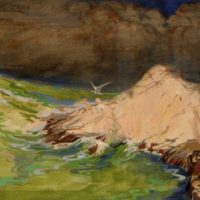 The Tale Of Kynon by George Sheringham
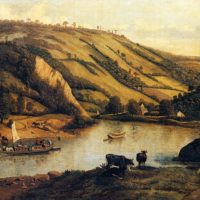 An Extensive River landscape, Probably Derbyshire, With Drovers And Their Cattle In The Foreground by Jan Siberechts
 Landscape with Rainbow, Henley-on-Thames by Jan Siberechts
 (No Ratings Yet)Loading...
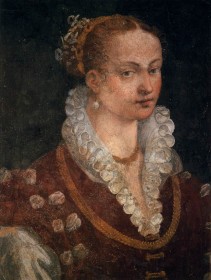
Grand Duke Francesco I de’ Medici was a man of profound and obsessive passions. The Uffizi galleries, which he established, were one, Bianca Cappello (1548-1587), his mistress, and afterwards, the second wife, was the other.
 (No Ratings Yet)Loading...
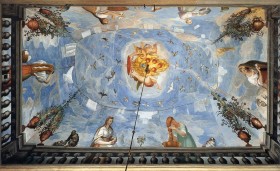
Pure genre scenes like the view of women hanging clothes to dry or combing their hair in the vault of a loggetta in the Palazzo Pitti are extremely rare in the monumental form of fresco decorations in the sixteenth century. Comparable scenes are, however, regularly found as elements of landscapes or grotesques.
 (No Ratings Yet)Loading...
In this painting the angels are dressing the dead Jesus. The subject is Byzantine in origin and rare in Western art. The mattress, covered with red velvet is a stylized variant of the “red-stone” relic, formerly in the Byzantine Pantokrator church. According to an apocryphal legend, Christ was lying on this stone when the angels anointed him and covered him with the shroud. The legendary event, shown on the small painting on copper, is supplemented with a liturgical reference: on the altar in the background, we can see a chalice, symbolizing the mystery of the Eucharist. Alessandro Allori works with definite contours, models like a sculptor and paints numerous small details. The painting is signed in the centre of the altar-step: ALESSANDRO BRONZINO ALLORI FACEVA.
 (No Ratings Yet)Loading...
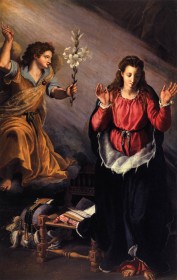
The layout of the composition played on the beam of light directed behind the Virgin Mary and the vivid piece of still-life in the foreground are already features of seventeenth-century painting.
 (No Ratings Yet)Loading...
Vassilacchi’s painting is on the wall of the Chapel of Our Lady of Peace. Formerly it was in the Scuola di Santa Croce at Belluno.
 (No Ratings Yet)Loading...
The Sala dello Scrutinio (Voting Hall) is the second largest hall of the Doge’s Palace. The balloting and secret votes of the magistracies and the doge took place in this hall with the very complicated systems that the Venetian Republic had created to avoid intrigues and subterfuge during the elections and, above all, to ensure that the vote could not be bought especially from the poor nobility in favour of its richer equivalent. The iconographic theme of the hall of the Sala dello Scrutinio was inspired by the Venetian naval victories on the Eastern seas shown in the numerous ceiling canvases depicting virtues and symbolic figures. Vassilacchi’s Conquest of Tyre on the wall of the Sala del Scrutinio depicts a historical event which occurred in […]

 (No Ratings Yet)Loading...
The Venus at Bath was commissioned in 1756 and completed c. 1767. Its concept, derived loosely from Giambologna, is much better than the execution, whereby the goddess remains lumpish and her draperies inert and mechanical. However, it was praised by Diderot. This appealed to Madame Du Barry, who obtained the Venus and placed it at Louveciennes, and commissioned in 1772 from the sculptor a pendant of virtually the same subject in less languorous mood: a Diana surprised by Actaeon (also in the Louvre, Paris), completed five years later and then exhibited in the artist’s studio.