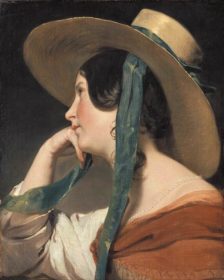
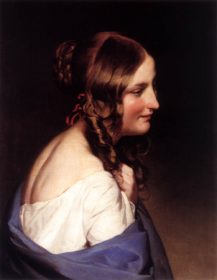
From the early 1830s to approximately 1850 Amerling was Vienna’s most celebrated portraitist. A likeness, almost identical to this portrait and entitled Modest Susanna, was executed in 1837. The portrait represents an example of one of Amerling’s favourite compositional schemata to position the bare-backed sitter, turned away from the beholder.
In this unfinished self-portrait the artist depicted himself in profile from the left and with a serious and attentive look. He dispensed with any attributes of his art, such as brush or easel, and did not adopt an artificial pose, contenting himself with a clearly circumscribed partial view.
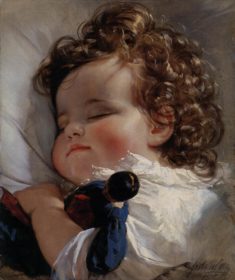
Friedrich Amerling painted several intimate portraits of the children of the Liechtenstein family.
Van Aelst painted this still-life (signed and dated lower right) in 1650, the year in which he entered the service of Ferdinand II de’Medici, grand duke of Toscany, and of his brother, Cardinal Carlo de’Medici. It is possible, that this painting was executed for the cardinal, who was the artist’s main patron in Florence. In this still-life Van AElst continues the tradition of fruit and flower painting that flourished in Delft from the early 1630s onward with the work of Balthasar van der Ast, Gillis de Bergh, and Evert van Aelst, Willem’s uncle.