
The intersection of styles characterizes this small panel, in which Northern elements traceable to Rogier van der Weyden are conspicuously present, but so are certain Vincenzo Foppa influences, mainly in the physiognomy of some figures in the middleground, in the facial types and some solutions in the drawing that were to remain unaltered in Bergognone’s works of subsequent years.
This is the companion-piece of the Portrait of a Young Man.
Until 1861 the painting was attributed to Hans Holbein the Younger. The picture, showing Venetian innfluences, is a masterpiece of the Renaissance painting in Augsburg. A companion-piece Portrait of a Young Woman is also in the Hermitage.
The composition of this painting is close to that of a large altarpiece painted by Altomonte in 1723-24 for high altar of the church of the Carmelites (Karmeliterkirche) in Linz. The painting is signed and dated bottom right: Martino Altomonte / Pinx. Ao. 1737.
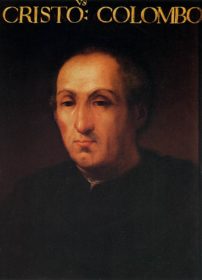
Christopher Columbus (c. 1451-1506) was a navigator, colonizer and explorer whose voyages across the Atlantic Ocean led to general European awareness of the American continents in the Western Hemisphere. This portrait was painted half a century after his death. There are no certain contemporary images of the navigator, who was only one among many when he first set out in ships funded in part by Medici money.
The view is probably a capriccio of various of the abbeys set among ponds in the rolling woodland to the south and east of Brussels.
Denis van Alsloot was a Flemish painter who specialized in pageant and procession scenes.
Cephalus and Procris were in Greek mythology a young couple, newly married, whose love was destined to end in tragedy. The figures in the painting are probably by another hand most likely to be Alsloot’s principle collaborator, Henderick de Clerck.