Dutch Archive

1 Star2 Stars3 Stars4 Stars5 Stars (No Ratings Yet)
Loading...

The ostentatious display of killed animals after hunt had a representational and symbolic function. The motif of a dead animal hanging upside down – an actual hunting custom – had been taken over by 17th century Dutch painters from earlier artists such as Jacopo de’ Barbari and Lucas Cranach the Elder.

Read More...

, ,

1 Star2 Stars3 Stars4 Stars5 Stars (No Ratings Yet)
Loading...

Willem van Aelst was a still-life specialist prized for his lovely flower and fruit pieces, and he has been mentioned as a sometime follower of Kalf. He also painted a number of elegant game pictures in a clear light. They show close views of dead prey – occasionally accompanied by killed poultry – that include scrupulously painted guns, hunting bags and horns, bells and other gear of the sport. As most trophy pieces they were designed as representative pictures of the sport, not records of the spoils of a specific hunt. In this picture the painter displayed the finely worked equipment of the huntsman on a marble ledge: a velvet hunting bag with chamois strap, trimmed with gold embroidery and fringes, and a tasseled horn. […]

Read More...

,

1 Star2 Stars3 Stars4 Stars5 Stars (No Ratings Yet)
Loading...

In addition to fruit and flower still-lifes with cool colour harmonies, van Aelst also enjoyed painting elegant hunting weapons and dead animals placed in a dark corner by a wall for rich clients. One example is this still-life. A dead partridge is hanging by its leg from a piece of string. Its wings and feathers, which are grey with brownish patches, open up towards us at the bottom like a fan. The fly on the light-coloured feathers has an illusionist effect: disproportionately large in size, it belongs to the realistic level of the picture rather than its fictitious one, so that the viewer is given the impression that a real fly is crawling across the painting. The bird’s head has been pressed slightly towards the […]

Read More...

, ,

1 Star2 Stars3 Stars4 Stars5 Stars (No Ratings Yet)
Loading...

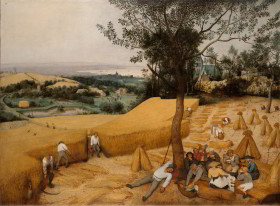
This is one of six panels painted by Pieter Bruegel the Elder for the suburban Antwerp home of the wealthy merchant Niclaes Jongelinck, one of the artist’s most enthusiastic patrons—Jongelinck owned no less than sixteen of Bruegel’s works. The series, which represented the seasons or times of the year, included six works, five of which survive. The other four are: The Gloomy Day, The Return of the Herd, Hunters in the Snow (all Kunsthistorisches Museum, Vienna), and Haymaking (Lobkowicz Collections, Prague). Through his remarkable sensitivity to nature’s workings, Bruegel created a watershed in the history of Western art, suppressing the religious and iconographic associations of earlier depictions of the seasons in favor of an unidealized vision of landscape. The Harvesters probably represented the months of August and September in the context of the […]

Read More...

, , ,