(No Ratings Yet)
 Loading...
 An English Frigate In The Bay Of Naples by John Thomas Serres
 Figures on a beach near Naples by Giovanni Serritelli
 View of Brussels from the NorthEast by Hercules Seghers
 Cattle watering in a River Landscape, believed to be Chile by Thomas Jacques Somerscales
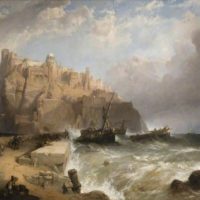 The Castle of Ischia by Clarkson Stanfield
 Landscape with Rocky Hills and Stream by William Louis Sonntag
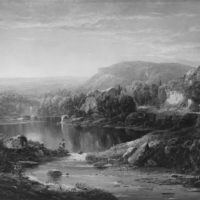 Landscape with Waterfall and Figures by William Louis Sonntag
 The Tale Of Kynon by George Sheringham
 An Extensive River landscape, Probably Derbyshire, With Drovers And Their Cattle In The Foreground by Jan Siberechts
 Landscape with Rainbow, Henley-on-Thames by Jan Siberechts
Women have been a major part of the art of painting. Whether it is the the Renaissance period, Dutch Golden age or the 21st century. Women in painting are mostly depicted as a sensual muse. But, on the other hand, feminine figures are also used to represent maternity, goddesses, innocence and beauty. Sometimes, women are used as symbols for various things including godly figures, sensual representations, lust, etc. The world’s most popular painting, Mona Lisa, is also a portrait of a woman.
Thus, women are a major part in the art of the painting, as obviously they are in the real life in every society. Due to the art periods, their representations have been changed, though. Before renaissance, around 12th and 13th century, the figure of a woman was mostly used to represent goddesses, Madonna or the followers of gods. Though, as the renaissance period (ranging from 14th to 17th century) brought big changes in every arts and subsequently in subjects, the element of woman changed its definitions to more sensual representation. In renaissance, artists trying to understand the human anatomy explored a woman’s body-structure and used that knowledge to enhance their perfection of women in the painting – just like they did with man’s anatomy.
During the renaissance, after learning to depict every curves of the body, the shift of representing women into a sensual subject was universal. Even in some religious subjects, women were portrayed in half or total nakedness. The change was admired by the most viewers and the legacy has continued today. Nowadays, depicting nude woman is nothing of a news. It is accepted as the basic learning curve for any new artist. There are many artists whose subject is particularly devoted to the nude women.
As always reflects the contemporary nature of the society and social views towards any subject, we can presume that over the years artists and art-admirers have accepted the element of woman in painting with more open-minded approach and with an artistic admiration. Today, we are standing about to reach the cultivation in conventional methods of arts and are trying to explore new methods. And in those new methods, the subject of women will bring new meanings, symbolism and aspects of the subject.
(No Ratings Yet)Loading...One of the period’s most inventive portraitists came from Cremona. The noblewoman Sofonisba Anguissola created wry and witty portraits of family members and acquaintances, a subject largely imposed upon her by societal restrictions on female access to models and patrons. Sofonisba’s painting of her teacher, painting her portrait – a story within a story – demonstrates how she negotiated her male-dominated world. Anguissola’s gaze rivets the viewer of the painting, forcing consideration of what appears to be the inscribing of male authority on the body of the female. Campi’s gaze complicates matters, however, since as he paints he, too, looks out of the painting toward what the picture indicates must be his subject, Anguissola. Thus the viewer in front of the painting plays a double […]
(No Ratings Yet)Loading...This is the companion-piece of the Portrait of a Young Man.
 (No Ratings Yet)Loading...
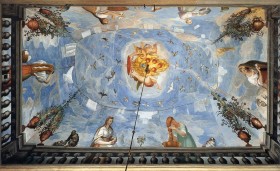
Pure genre scenes like the view of women hanging clothes to dry or combing their hair in the vault of a loggetta in the Palazzo Pitti are extremely rare in the monumental form of fresco decorations in the sixteenth century. Comparable scenes are, however, regularly found as elements of landscapes or grotesques.
 (No Ratings Yet)Loading...
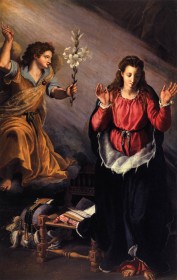
The layout of the composition played on the beam of light directed behind the Virgin Mary and the vivid piece of still-life in the foreground are already features of seventeenth-century painting.
 (No Ratings Yet)Loading...
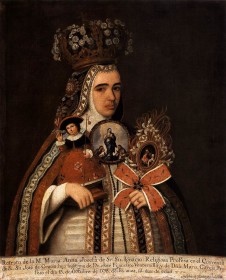
Alcibar was a famous painter in Mexico in the viceregal period. He painted murals in many cathedrals, and painted portraits of nuns. In 18th-century Mexico hundreds of portraits were produced on the occasion of taking vow of chastity of young girls going to a convent. This painting representing a 16 years old girl belongs to this series.