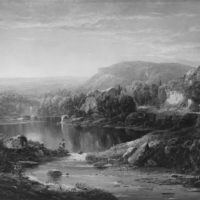
Cephalus and Procris were in Greek mythology a young couple, newly married, whose love was destined to end in tragedy. The figures in the painting are probably by another hand most likely to be Alsloot’s principle collaborator, Henderick de Clerck.
Oil Paintings
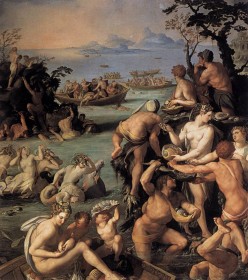
The Studiolo is a tiny chamber in the Palazzo dei Priori (Palazzo Vecchio), accessible by a hidden spiral staircase. It was dedicated to the geological, mineralogical and alchemical interest of Francesco I de’ Medici, son and successor of Cosimo I. Its walls are lined with two tiers of oil paintings on slate or panel that act as doors for cupboards containing Francesco’s scientific books, specimens, and instruments. Alessandro Allori’s contributions to the decoration of the Studiolo in the Palazzo Vecchio included the Pearl Fishers. Allori was the follower of Agnolo Bronzino, and his style imitates the cool, smooth manner of his teacher. Exquisite male and female nudes, human and mythological, play about on rocks, dive off boats, and bring up shells overflowing with seawater and […]
In this painting the angels are dressing the dead Jesus. The subject is Byzantine in origin and rare in Western art. The mattress, covered with red velvet is a stylized variant of the “red-stone” relic, formerly in the Byzantine Pantokrator church. According to an apocryphal legend, Christ was lying on this stone when the angels anointed him and covered him with the shroud. The legendary event, shown on the small painting on copper, is supplemented with a liturgical reference: on the altar in the background, we can see a chalice, symbolizing the mystery of the Eucharist. Alessandro Allori works with definite contours, models like a sculptor and paints numerous small details. The painting is signed in the centre of the altar-step: ALESSANDRO BRONZINO ALLORI FACEVA.
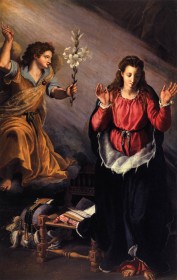
The layout of the composition played on the beam of light directed behind the Virgin Mary and the vivid piece of still-life in the foreground are already features of seventeenth-century painting.
Vassilacchi’s painting is on the wall of the Chapel of Our Lady of Peace. Formerly it was in the Scuola di Santa Croce at Belluno.
The Sala dello Scrutinio (Voting Hall) is the second largest hall of the Doge’s Palace. The balloting and secret votes of the magistracies and the doge took place in this hall with the very complicated systems that the Venetian Republic had created to avoid intrigues and subterfuge during the elections and, above all, to ensure that the vote could not be bought especially from the poor nobility in favour of its richer equivalent. The iconographic theme of the hall of the Sala dello Scrutinio was inspired by the Venetian naval victories on the Eastern seas shown in the numerous ceiling canvases depicting virtues and symbolic figures. Vassilacchi’s Conquest of Tyre on the wall of the Sala del Scrutinio depicts a historical event which occurred in […]
Allegrain followed Poussin by painting heroic landscapes.
The style of the Flemish painters, who brought with them the new technique of transparent oil painting, was adopted by the court of Castile in the second third of the fifteenth century. Among the pioneers of this style was Louis Alincbrot who painted the complex triptych depicting scenes from the life of Christ. The picture shows the central panel of the triptych which depicts Jesus Debating with the Doctors of the Church, The Road to Calvary, and in the background, The Crucifixion. The left panel depicts The Circumcision, while the on the right has a Pietà, with the sarcophagus for Christ’s burial in the background.