 (No Ratings Yet)
 Loading...
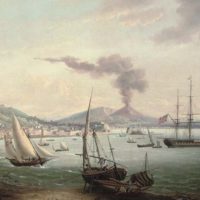 An English Frigate In The Bay Of Naples by John Thomas Serres
 Figures on a beach near Naples by Giovanni Serritelli
 View of Brussels from the NorthEast by Hercules Seghers
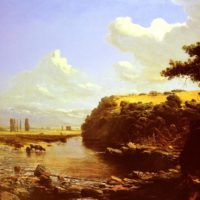 Cattle watering in a River Landscape, believed to be Chile by Thomas Jacques Somerscales
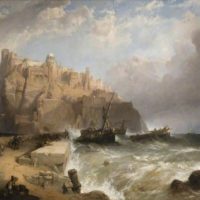 The Castle of Ischia by Clarkson Stanfield
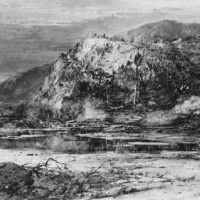 Landscape with Rocky Hills and Stream by William Louis Sonntag
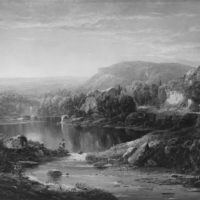 Landscape with Waterfall and Figures by William Louis Sonntag
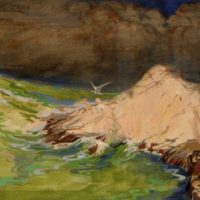 The Tale Of Kynon by George Sheringham
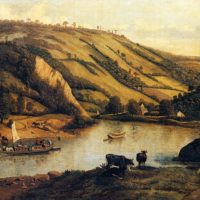 An Extensive River landscape, Probably Derbyshire, With Drovers And Their Cattle In The Foreground by Jan Siberechts
 Landscape with Rainbow, Henley-on-Thames by Jan Siberechts
 (2 votes, average: 4.00 out of 5)Loading...
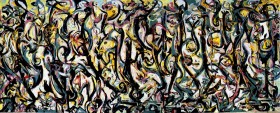
“It’s a stampede… [of] every animal in the American West, cows and horses and antelopes and buffaloes. Everything is charging across that goddamn surface.”These are the words of Jackson Pollock on his piece ‘Mural’ made in 1943. As it came out, most critics adored it and welcomed it with greetings. Some also considered it one of the best productions by the artist. The painting itself is very large being sized of 8 by 20 feet. It was made on the commission given by Peggy Guggenheim. Recommended Books Jackson Pollock’s Mural: The Transitional Moment
 (No Ratings Yet)Loading...
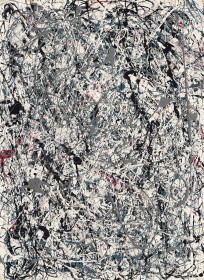
At closer look, Jackson Pollock’s paintings seems to be more of an impasto art-work with its thick colors almost protruding out of the painting and generating shadows near those thick color-lines. It creates a fine surface which becomes a part of the art. Number 19, 1948 is similar painting with thick color implementation. At some places, you can almost see thick droplets. That’s how they are called the Drip paintings of Jackson Pollock. Number 19, 1948 Analysis The Painting is no exception of the drip painting technique. There are maximum 6 colors apparent: ivorish- white as the main background. Over that are the black, grey and bluish green colors. Minorly used colors are red and very tiny specks of yellow at some places which could […]
 (1 votes, average: 5.00 out of 5)Loading...
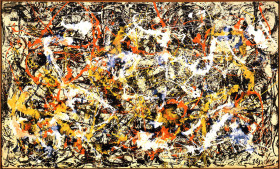
Jackson Pollock’s known Drip painting Convergence holds many shades of colors, different with intensity contrast and depth is an Abstract Expressionist art-work. Unlike his famous works No 5, 1948, Mural or The Deep, this piece holds much more bright and contrasting color making it eye-catching. Jackson Pollock’s most paintings where large at size. This one is no exception. The canvas is the size of around 8 x 13 feet. It takes up a whole wall in the Albright-Knox Art Gallery, Buffalo, N.Y where it currently resides.
 (13 votes, average: 4.15 out of 5)Loading...
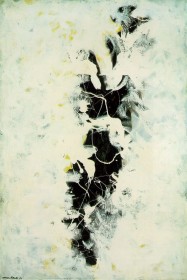
Jackson Pollock’s Drip paintings became known to the world from 1940s and 1950s when his star was the brightest in his whole career. The American artist’s whole career was based on newly invented technique which is sometimes described as the blend of Abstract Expressionism, Surrealism and Cubism with his own Drip technique. This blend mostly created a joyous creation which would get the viewer’s attention and get them instantly interpreting the work. Pollock’s popular work, No. 5, 1948 (ranking in world’s most expensive paintings sold) is a good example of it. The Deep Analysis The current painting is mostly done with black and white, the essential colors. There are some specks of light blue and yellow, though. Just like Pollock’s other works, it’s huge with […]
 (No Ratings Yet)Loading...
Number 11, 1952 is, as the title suggests, a painting made by the American Drip Painting artist Jackson Pollock in 1952. It ranks among one of the most famous works by Pollock. Initially, as the painter prefers, the title of the painting was simply as Number 11, 1952 but later on in 1954, Pollock gave it another name alongside, Blue Poles. Some critics were disgruntled by the name alteration/addition, saying that a verbal name for such drip painting was limiting the viewers’ imagination by forcing them to search for the blue poles. Instead, the numerical names which artist always gave to the public provided the freedom to interpret and understand the art-work according to their temperament. That’s what, as said, was the essence of a […]
 (4 votes, average: 4.25 out of 5)Loading...
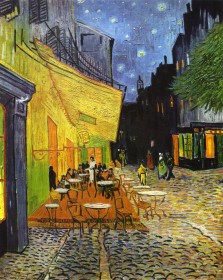
Exaggerated portrayal of a real place in Arles, France, Café Terrace at Night is much revered painting. In modern times, the real café on which the artist drew his painting is renamed as the Café Van Gogh and is reconstructed so it could look like the café in the painting. That’s the height of the painter in today’s time. Many visitors visit the café and stands at where Van Gogh placed his easel. As Van Gogh wrote in his letter to his brother Theo, the painting doesn’t depict the exact scenario of the place. The bright orangish-yellow and green texture of the café is the artist’s creation as well as the brightly blue starry night which artist described as a containing poor pale whitish light. […]