
 (2 votes, average: 4.50 out of 5)
 Loading...
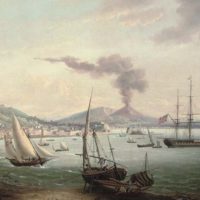 An English Frigate In The Bay Of Naples by John Thomas Serres
 Figures on a beach near Naples by Giovanni Serritelli
 View of Brussels from the NorthEast by Hercules Seghers
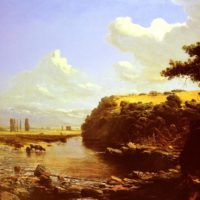 Cattle watering in a River Landscape, believed to be Chile by Thomas Jacques Somerscales
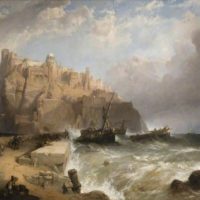 The Castle of Ischia by Clarkson Stanfield
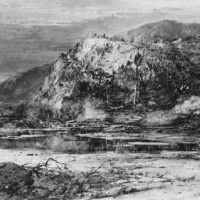 Landscape with Rocky Hills and Stream by William Louis Sonntag
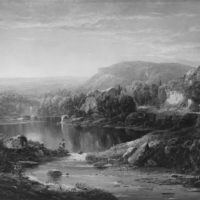 Landscape with Waterfall and Figures by William Louis Sonntag
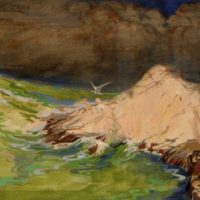 The Tale Of Kynon by George Sheringham
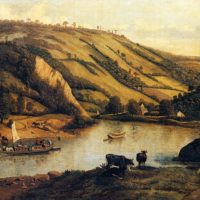 An Extensive River landscape, Probably Derbyshire, With Drovers And Their Cattle In The Foreground by Jan Siberechts
 Landscape with Rainbow, Henley-on-Thames by Jan Siberechts
 (2 votes, average: 4.00 out of 5)Loading...
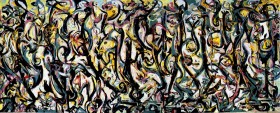
“It’s a stampede… [of] every animal in the American West, cows and horses and antelopes and buffaloes. Everything is charging across that goddamn surface.”These are the words of Jackson Pollock on his piece ‘Mural’ made in 1943. As it came out, most critics adored it and welcomed it with greetings. Some also considered it one of the best productions by the artist. The painting itself is very large being sized of 8 by 20 feet. It was made on the commission given by Peggy Guggenheim. Recommended Books Jackson Pollock’s Mural: The Transitional Moment
 (6 votes, average: 3.50 out of 5)Loading...
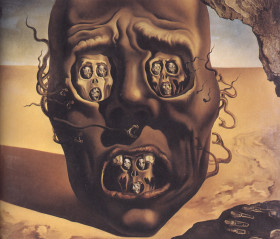
The Face of War is Spanish artist Salvador Dali’s attempt to impersonate war itself. It is depicted terrifying, unlikable and to some extent, scary. It was made in 1940 right after the end of the Spanish Civil War and before the beginning of the second World War. The Face of War Analysis The setting is of a desert at the time of late evening when the sun is still lingering near the horizon. The face is dismembered from its body and has withered to death. Though, there are expressions on it. Expressions which are left on a dead man’s face. It’s shock and misery. The face is in the awe by the happenings of a war. On the both sides, it is covered with alive […]
 (No Ratings Yet)Loading...
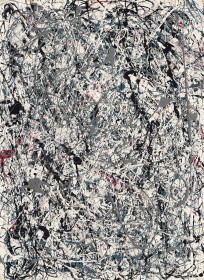
At closer look, Jackson Pollock’s paintings seems to be more of an impasto art-work with its thick colors almost protruding out of the painting and generating shadows near those thick color-lines. It creates a fine surface which becomes a part of the art. Number 19, 1948 is similar painting with thick color implementation. At some places, you can almost see thick droplets. That’s how they are called the Drip paintings of Jackson Pollock. Number 19, 1948 Analysis The Painting is no exception of the drip painting technique. There are maximum 6 colors apparent: ivorish- white as the main background. Over that are the black, grey and bluish green colors. Minorly used colors are red and very tiny specks of yellow at some places which could […]
 (13 votes, average: 4.15 out of 5)Loading...
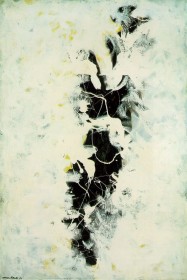
Jackson Pollock’s Drip paintings became known to the world from 1940s and 1950s when his star was the brightest in his whole career. The American artist’s whole career was based on newly invented technique which is sometimes described as the blend of Abstract Expressionism, Surrealism and Cubism with his own Drip technique. This blend mostly created a joyous creation which would get the viewer’s attention and get them instantly interpreting the work. Pollock’s popular work, No. 5, 1948 (ranking in world’s most expensive paintings sold) is a good example of it. The Deep Analysis The current painting is mostly done with black and white, the essential colors. There are some specks of light blue and yellow, though. Just like Pollock’s other works, it’s huge with […]
 (3 votes, average: 3.00 out of 5)Loading...
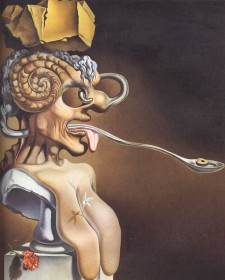
This is an ambivalent painting of cubist artist Pablo Picasso by the surrealist master Salvador Dali produced in the year of 1947. Portrait of Picasso Analysis The surrealist portrait painting of Pablo Picasso by Salvador Dali is infused with symbolic messages and meanings as Dali’s most famous works are. Basically, instead of a direct face, it is a portrait of Picasso’s bust sculpture. The base of the bust is made out of the regular white stone out of which most bust-sculptures are made of. But, the upper part is covered with skin. There is a white flower in the distorted chest of the bust, while a red one, is laying at the feet of the bust. The head is much more distorted than the chest […]
 (No Ratings Yet)Loading...
Number 11, 1952 is, as the title suggests, a painting made by the American Drip Painting artist Jackson Pollock in 1952. It ranks among one of the most famous works by Pollock. Initially, as the painter prefers, the title of the painting was simply as Number 11, 1952 but later on in 1954, Pollock gave it another name alongside, Blue Poles. Some critics were disgruntled by the name alteration/addition, saying that a verbal name for such drip painting was limiting the viewers’ imagination by forcing them to search for the blue poles. Instead, the numerical names which artist always gave to the public provided the freedom to interpret and understand the art-work according to their temperament. That’s what, as said, was the essence of a […]
 (1 votes, average: 4.00 out of 5)Loading...
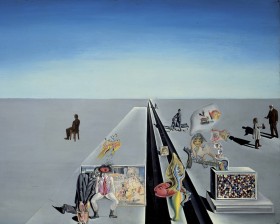
This is one of the earliest surrealist paintings from Salvador Dali. It was produced in 1929 when Dali was around 25 years old. He had completed his short experiments with Cubism and was getting allured towards the Surrealism which he expanded largely in his later life. The First Days of Spring Analysis There is a large, endless grey platform spreading on all sides visible in the scene. In the middle, the platform lowers itself two steps on the left side. Normal, natural, abnormal, unnatural, dreamy…all types of elements are put on this big plain in arbitrary manner. Some resembles to the real life natural objects, on the other some are very bizarre and somewhat nightmarish. For example, a feminine figure sitting on the lower left […]