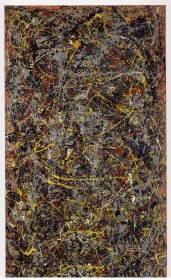
Jackson Pollock was very much popular during 1940s and 1950s for his Drip Paintings. He had invented a whole new style with thick paint and big brushes on canvases large enough to cover entire walls. He would lay those canvases on the ground and than after putting a leg on the canvas, he would begin to paint his masterpieces. The outcomes would be totally unconventional, unprecedented and intriguingly beautiful. No. 5, 1948 Analysis The presented piece is his most known, famous art-piece and the peak of his drip paintings.The style of the painting is called Abstract Expressionism. It also has some elements of Impasto technique. The design seems to be forming a pattern similar to a nest or thick threads put disorderly on each other. Either way it is […]
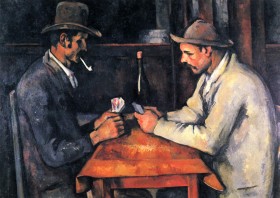
There are total of five version of the painting. A series, in which this painting is one of the last two versions, became the most expensive painting ever as the State of Qatar bought it from a private auction. The price is said to be $ 259 million at the time and broke the previous record of $ 140 million held by Jackson Pollock’s No. 5, 1948 sold in 2006. This amazing monetary value surely has some other factors apart from its artistic distinctness. Reason could vary from personal interest or investment strategies. But, on the artistic side, the composition of the painting has become legendary. People are copying it in their paintings and also have followed the whole oeuvre of Paul Cezanne for further […]
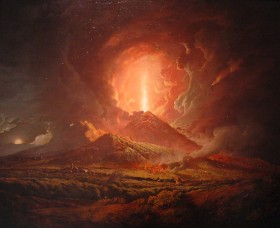
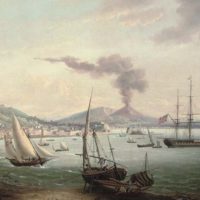
Natural disasters are never welcomed in human society. They are the bringer of death, catastrophic deaths which puts havoc in the flourishing, prospering societies. They play more of a villainous role. On the other hand, every natural disaster is grand show. A show which once seen can never be forgotten throughout the entire life. A scene which gets hardwired in the human brain, among the neurons that it can’t be undone, especially if it is volcanic eruption. Such volcanic eruptions are the event to behold for a long time. They doesn’t let the viewer even blink their eyes and mesmerizes them to its grand presence, power and makes them feel so tiny and defenseless, that any human being can’t get his head out of the […]
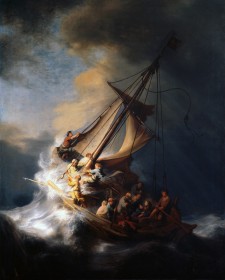
This dramatic illustration, “The Storm on the Sea of Galilee”, is painted by the Dutch Golden Age master Rembrandt. It is a dramatic depiction of the ‘calming the storm’ miracle done by Jesus. Jesus did many miracles in his lifetime including walking on water, cursing the fig tree, turning water into wine and many more. Those miracles and anecdotes made his apostles and followers have more faith in him. Though, as it is obvious in the stories, Jesus never exhibited his powers in public until it was a sheer necessity. Here, he is crossing the Sea of Galilee with his apostles and other Jewish people. The sea was known for its sudden storms and taking lives of people. Such a storm came across with this […]
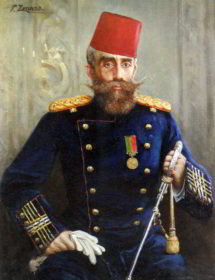
If you are aware of the political games played across portals of power, you may not find too hard to believe that the Bolsheviks were encouraged to make their aggression against Eurasian monarchies by many western minds to gain some sort of control over the region. One of the heroes resisting the rebellious movement was Mahmud Sevket Pasha of Turkey. It raged fiercely in the political arena by the end of 1909, as the rebels were demanding an overthrow of the constitutional monarchy in the Ottoman region. By the time it had gained enough fanning to get violent and conspiratorial, the Pasha was able to subdue the forces adequately, to the effect that it brought an end to the movement and the probable mayhem. However, […]
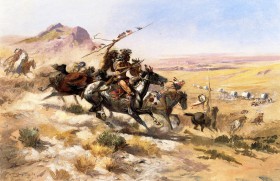
This 1902, oil-on-canvas painting , “Attack on a Wagon”, is a work of an Old American West artist Charles Marion Russell known as the ‘cowboy artist’. It is a depiction of a bunch of red-Indians attacking on the wagon train of white men. The scene is from the time around mid-1800s, when the American government started to expand their lands. In this process, the wide-spread red-Indians across all of the USA were the main interruption for the government. Government used harsh techniques in the acquisition. By attacking on the tribes with much advanced and powerful weapons than those traditional Indians who had spears as the most advanced technology. To stay safe, some tribes leaned under and started to live on the lands given by the government. […]
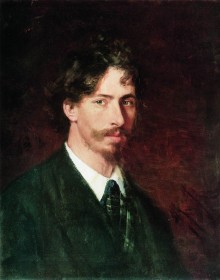
Ilya Repin, a painter who enjoyed the similar fame in Russian painting to the Leo Tolstoy in Literature is the very well-known figure in entire Russian artist community. He is respected, looked upon and followed by many new artists. His roots are found in the small town of Chuguyev where he was born on 5th August, 1844. The small child didn’t know what he was going to become until the age of 12. In 1856, he became the pupil of Ivan Bunakov and learned the basics of the art he would live for. The initial learning and attending art schools, academies is a routine for an artist, expect the artist is a self-taught. When he grew up and learned how to handle the brush on […]
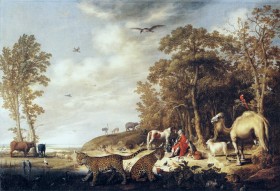
You may have heard about the mystical figure of Orpheus from the Greek mythology. But, I think the background story needs to be told to understand the essence of this artwork. Orpheus was a proficient poet and musician with the magical ability to mesmerize all living things with his music. It was an incredible expertise for a musician. That’s why, everyone was always so eager to hear him. The legend goes further with the death of his wife. To redeem her from the grip of death, he went to the underworld. By his music, the things living in underworld got mesmerized and allowed him pass all the way to the Hades – the underworld king. Hades heard about his misery and decided to let his […]
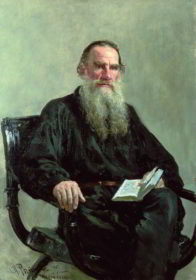
Title of the painting represents two greatest artists from Russia. One is Ilya Repin himself and another is Leo Tolstoy, who doesn’t need any introduction. They both were ample artists and Ilya Repin is said to enjoy a respect in his art similar to Leo Tolstoy enjoyed in his literature. The convergence of these two big figures in one art-work is enough to make the art-work utterly important. Ilya Repin painted many portraits of Leo Tolstoy after they befriend in 1878. Leo Tolstoy Ploughing, Leo Tolstoy Barefoot and a pencil work called Leo Tolstoy Reading are the three works associated to Leo Tolstoy other than the current picture. Ilya Repin painted this portrait of Leo Tolstoy in 1887 with oil on canvas. It represents the […]
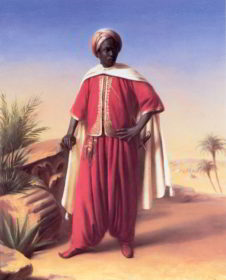
In his time, painter of the “Portrait of an Arab”, Horace Vernet didn’t need an introduction, as he worked for the contemporary King Louis-Philippe and Napoléon III of France. Though, he is still remembered with an honor in art-communities. In early 19th century, he was renowned for his great artworks like Dog of the Regiment, Death of Poniatowski and Battle of Montmirail. His fields of interests varied only between portraits, Arabians and battles. And he didn’t want to paint in the traditional ways. He had grown a particular disinclination with traditional idealized ways of paintings. He wanted to draw things with more general touch and feel, instead of giving his subjects an idealized pose; he created his paintings with more vernacular manner. Thus, the viewer […]