

Dutch Archive

1 Star2 Stars3 Stars4 Stars5 Stars (2 votes, average: 5.00 out of 5)
Loading...

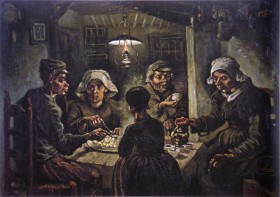
“You see, I really have wanted to make it so that people get the idea that these folk, who are eating their potatoes by the light of their little lamp, have tilled the earth themselves with these hands they are putting in the dish, and so it speaks of manual labor and — that they have thus honestly earned their food. I wanted it to give the idea of a wholly different way of life from ours — civilized people. So I certainly don’t want everyone just to admire it or approve of it without knowing why.” This statement by Vincent van Gogh clarifies his intentions to draw the painting and can’t be interpreted more correctly. To portray this scene he did years of research […]
Read More...

, , , ,

1 Star2 Stars3 Stars4 Stars5 Stars (22 votes, average: 4.27 out of 5)
Loading...

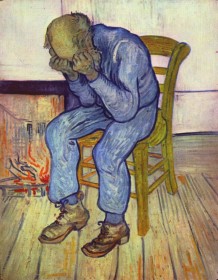
Displaying mental distress with insane feelings of the sorrow, the picture describes an old man crying over for unknown reasons.  He is stressed out and looks unable to bear any more stress as he is trying to hide from the tensed world by concealing his eyes behind his fists. The support by the elbow represents his weakness and inability to cope more with the undesired situations. The strongly closed fist may represent the anger inside him which has aroused after many years of anxiety and strain as those are the essential factors for anger. The flames in the fireplace at backdrop may represent the fiery agony by which the old man is suffering and has become an infinite struggle. Van Gogh firstly made draft of […]

Read More...

, , , , , , , , ,

1 Star2 Stars3 Stars4 Stars5 Stars (3 votes, average: 3.33 out of 5)
Loading...

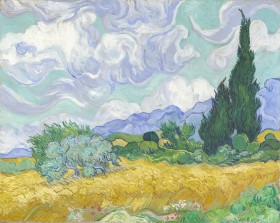
This painting is a part of the series Cypresses by Van Gogh produced in 1889-1890. The represented one is the most popular as it got famed in 1993 after its sell to Walter H. Annenberg for an equivalent amount of $ 86.3 million. It is considered as the artist one of the masterpieces. Though, if one takes a closer look at the painting, he learns that the depiction is more related to his fantasy than the reality as if he just watched the real scene and then depicted it in his own style of broken brush and post-impressionist vivid colors. This portrayal from his last days has filled with vibrant and close to original colors as he accepted the post-impressionism. Van Gogh’s prominent works has […]

Read More...

, , , , , , ,

1 Star2 Stars3 Stars4 Stars5 Stars (5 votes, average: 3.20 out of 5)
Loading...

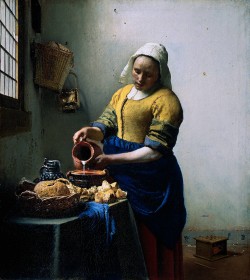
The Milkmaid ranks among Johannes Vermeer’s best known works. It is known for its ample depiction and also for multiple interpretations viewers and critics make, which ranges from pragmatic views to theoretical meanings. The painting origins from the 17th century of Dutch Golden Age. The Subject The subject of the painting is a Milkmaid pouring fresh milk in a bowl. Though, in the 17th century Dutch people didn’t have special Milkmaids. They were called “Kitchen maids” or ‘maid of all works’. Such maids were subject to do all types of works necessary in the kitchen or house. Also, such kitchen maids were also predisposed for love and sex. It wasn’t unapproved in society. The Milkmaid Analysis Vermeer has depicted the scene and the woman with […]

Read More...

, , , , ,

1 Star2 Stars3 Stars4 Stars5 Stars (3 votes, average: 3.67 out of 5)
Loading...

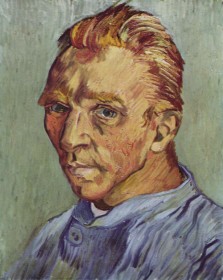
Being in our post of Legend of Vincent van Gogh, the Dutch artist’s this priciest portrait with a huge price tag of $ 71.5 million around 15 years before in 1998 was the third costliest painting of all the time and fourth if we consider the price-inflation. And it is still an impressive rank for a portrait. Alongside with its enormous price-tag there are other facts which make this painting unique from the rest of the self-portraits by Vincent van Gogh which are totals more than 35. This self-portrait executed in 1889, was the last self-portrait by the artist. After that he majorly focused upon the cypresses and wheat fields. Moreover, this is the only painting depicting the artist without beard. As Van Gogh’s many […]

Read More...

, , , , , ,

1 Star2 Stars3 Stars4 Stars5 Stars (3 votes, average: 5.00 out of 5)
Loading...

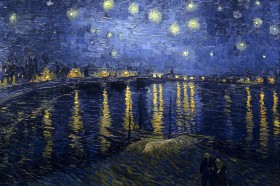
Painting executed in the same city and in the same month, in which the Café Terrace at Night was produced, Starry Night over the Rhone captures a different view and different angle of the beautiful city cited in Paris. Rhone – that which rolls – is an important river running through Arles. Its importance and the beauty at night maybe allured the artist to illustrate it with oil on his canvas. Van Gogh has never tried to depict scene in their natural conditions. He always twisted the scenes and added imaginary colors and portions to the scene to get the exact impact he willed for. Adding artificial color to the image was a new idea in his time and Van Gogh used it very well […]

Read More...

, , , , ,

1 Star2 Stars3 Stars4 Stars5 Stars (No Ratings Yet)
Loading...

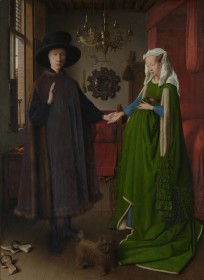
A well-known painting by the Dutch artist Jan van Eyck for the breath-taking depiction and also for the hidden “Easter egg.” The painting is of the Italian merchant Giovanni Arnolfini and his wife, also commissioned by him to portray his marriage. The genre or the painting has been called as Double portrait or sometimes as the primitive genre painting after renaissance as it depicted a marriage – a real life, “normal” incident. The room is presumed to be merchant’s own house in Bruges. The dog at their feet is the early breed of today’s Griffon Bruxellois. The Arnolfini Wedding Analysis Most historians take the double portrait as the wedding scene or the representation of their marriage. There are some alleged proofs to support this claim. […]

Read More...

, , , , , , , , , , , , ,

1 Star2 Stars3 Stars4 Stars5 Stars (No Ratings Yet)
Loading...

This painting includes a total of 112 Natherlandish proverbs in a single scene. The proverbs are taken literally. For instance, “To crap on the world” is literally represented as a person crapping on a globe. The depiction is on the left corner of the picture where a man in red clothes is coming out of a window. Artist of the Flemish renaissance from 16th century, Pieter Bruegel the Elder was known for similar works, which included The Seven Deadly Sins, The Months, Big Fish Eats Little Fish and The Blind leading the Blind.   Pieter Bruegel the younger, the artist’s son had depicted more than 20 versions of the paintings. Here is one of them.

Read More...

, , , , , , , , , , , ,

1 Star2 Stars3 Stars4 Stars5 Stars (No Ratings Yet)
Loading...

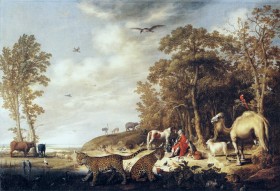
You may have heard about the mystical figure of Orpheus from the Greek mythology. But, I think the background story needs to be told to understand the essence of this artwork. Orpheus was a proficient poet and musician with the magical ability to mesmerize all living things with his music. It was an incredible expertise for a musician. That’s why, everyone was always so eager to hear him. The legend goes further with the death of his wife. To redeem her from the grip of death, he went to the underworld. By his music, the things living in underworld got mesmerized and allowed him pass all the way to the Hades – the underworld king. Hades heard about his misery and decided to let his […]

Read More...

, , , , , ,

1 Star2 Stars3 Stars4 Stars5 Stars (No Ratings Yet)
Loading...

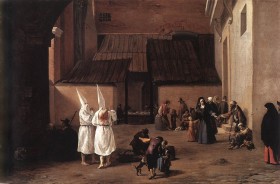
The two people in white robes with their backs wounded by their own torture pulled on themselves are called the Flagellants – the ones who torture themselves for their religious beliefs. It was a common practice Europe in around 13th and 14th century. People revered and honored them until the followers of Flagellantism aroused beyond the expectations of Roman Catholic Church and the Church denounced them heretics. After that the followers of the Flagellantism declined and people also started to ignore such self-harming religious persons. Their popularity declined drastically, though, even today, in different cultures flagellantism in different forms of self-harming exists. Whether it is the women’s self-harming in native African tribes or the 10th day of Muharram on which Muslims beat themselves in the […]

Read More...

, , ,