
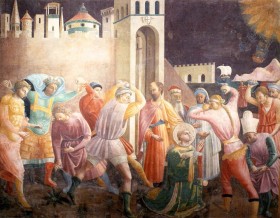
One of Paolo Uccelo’s works in fresco is perhaps the biggest St. Stephen moment, and probably the most inspiring biblical story by the medieval painter. An Italian masterpiece with historical significance is always an attraction for someone interested in European art. The martyrdom of St. Stephen is an inspiring event, which can be seen in contemporary sense as someone sacrificing himself to protect free speech rights under a dictatorship. St. Stephen’s legend spread further and wider than Jesus, and his popularity led to the first trans-continental presence of Christianity. Stephen was in many ways more popular than Jesus, and Uccelo is one of the main protagonists in popularizing the martyrdom, and what it had to contribute to Christian living. Much like a good disciple of […]
15th Century Archive
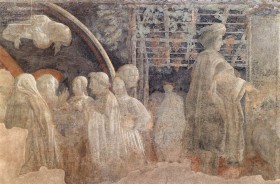
No matter how tragic Noah’s story, it is world-shattering enough for biblical painter Paolo Uccelo to have left the legend on a 17 by 9 feet fresco – which actually took Uccelo 4 years to paint in mid-15th century Italy. Noah, or the father of modern humans, is an age-old character, in Christian, Jew as well as Muslim history. According to many historians, the events surrounding Noah’s life, the flood and everything about his drunkenness took place around the 12000-10000 BC period. During this phase, many parts, including India, Antarctic Africa and South America were forced to change their coastlines owing to massive and life-taking floods over centuries. However, Noah could have also lived during the next great flood, which primarily affected northern Africa, ancient […]
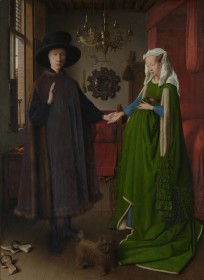
A well-known painting by the Dutch artist Jan van Eyck for the breath-taking depiction and also for the hidden “Easter egg.” The painting is of the Italian merchant Giovanni Arnolfini and his wife, also commissioned by him to portray his marriage. The genre or the painting has been called as Double portrait or sometimes as the primitive genre painting after renaissance as it depicted a marriage – a real life, “normal” incident. The room is presumed to be merchant’s own house in Bruges. The dog at their feet is the early breed of today’s Griffon Bruxellois. The Arnolfini Wedding Analysis Most historians take the double portrait as the wedding scene or the representation of their marriage. There are some alleged proofs to support this claim. […]
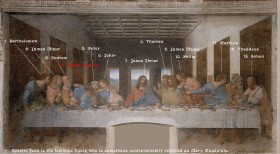
In The Last Supper by Leonardo da Vinci, there are total of 13 apparent figures apparent – if we ignore the controversial and sometimes conjured up figures in the painting. Twelve of them are the 12 apostles of Jesus while the central figure is Jesus Christ himself. The 12 apostles are grouped into the team of 3. Thus, total of 4 groups of Apostles are there. In the second group made of Judas, Peter and John is where the most controversies circles around. It holds the two characters that had radical impacts on Jesus’s life. As everybody knows, Judas was the reason to make this supper of Jesus the last supper. Here is brief information on each of the characters: 1. Bartholomew Born and died: […]
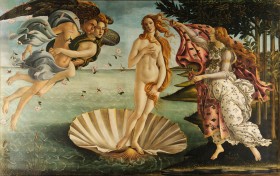
The Birth of Venus is equally famous work of Sandro Botticelli with Primavera. It simply depicts the moment of the birth of the love-goddess Venus in renaissance era style. It holds a much lesser approach of the renaissance era’s masculine and somewhat three-dimensional depictions. The painting seems more linear and flat in comparison to the other famous works from the same era. In Roman mythology Venus (Aphrodite in Greek mythology) is the goddess of divine love, sex, beauty, seduction and all the persuasive feminine aspects. She symbolizes the intellectual and physical love, attractions. Sometimes she is referred as the heavenly goddess of intellectual love and at many places she is said to be the earthly goddess of physical love or sex. Myth of Birth of […]
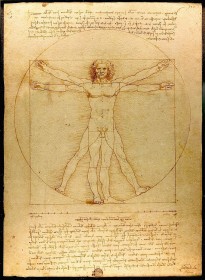
Vitruvian Man is Leonardo da Vinci’s most famous drawing and maybe world’s most popular drawing, too. It represents the proportion of an idle human body. There are two drawings of a naked men superimposed on each other with arms and legs spread out on different angles. Around the men, there are two geometric shapes, a circle and a square. Both, shapes touch at significant points to the men’s drawings, quickly making us realizing that there are some calculations hidden in an average human body. Vitruvian Man is now a representative of a perfect human body and sometimes it also stands for a perfect human as well. It is a huge accomplishment for a mere piece of paper and the artists who drew it. Though, the “fun […]
Leonardo executed very few works during his lifetime compared to other renaissance artists. A major reason is that, he was involved in way too much other works associated with science of human anatomy, botany, physics, armory, architecture and many others. But, on the other hand, his deep research and observation in each field helped him between his various fields at some points. The field of painting includes almost everything the nature has to offer and Leonardo just observed everything from fossils, mountains to the moon. Deriving information and hidden facts (for his time) from sources, mostly his every painting came out as a masterpiece from the artistic view point. His every new composition, color, style and new techniques were followed by the Leonardeschi. Sfumato After […]
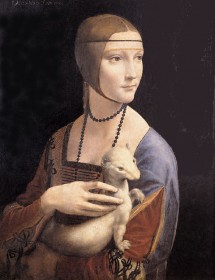
Lady with an Ermine is one of the four ladies painted by Leonardo, other three being Mona Lisa, La belle ferronnière and Ginevra de’ Benci. The Lady with an Ermine has segments of Pentimento as by radiography. A window has been detected on the upper right side, which was deleted later on by the artist. The painting consist some work called “Moti Mentali” meaning mental emotions. The term was mostly referred to Leonardo’s work and means the artist’s ability to depict the real mental thoughts, emotions and disposition of the subject on his/her face. That’s the painting has been described as “signaling a breakthrough in the art of psychological portraiture.” Another noticeable element is artist’s little use of his well-known style of Sfumato around the subject’s […]


(1 votes, average: 4.00 out of 5)


(2 votes, average: 4.50 out of 5)