
Centuries Archive

1 Star2 Stars3 Stars4 Stars5 Stars (No Ratings Yet)
Loading...

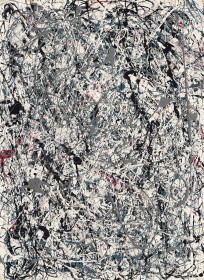
At closer look, Jackson Pollock’s paintings seems to be more of an impasto art-work with its thick colors almost protruding out of the painting and generating shadows near those thick color-lines. It creates a fine surface which becomes a part of the art. Number 19, 1948 is similar painting with thick color implementation. At some places, you can almost see thick droplets. That’s how they are called the Drip paintings of Jackson Pollock. Number 19, 1948 Analysis The Painting is no exception of the drip painting technique. There are maximum 6 colors apparent: ivorish- white as the main background. Over that are the black, grey and bluish green colors. Minorly used colors are red and very tiny specks of yellow at some places which could […]
Read More...

, ,

1 Star2 Stars3 Stars4 Stars5 Stars (1 votes, average: 5.00 out of 5)
Loading...

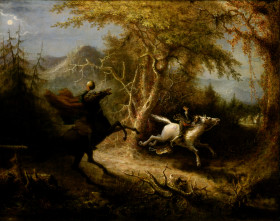
American painter John Quidor has depicted a famous scene from the short story collection The Legend of Sleepy Hollow by Washington Irving. The story is about a girl who is sought by two men. The ill-hearted person doesn’t get the girl at the end and on the return to his hometown, he gets persuaded by a ghost of a headless horseman in the haunted jungle on the road. The painting above is the representation of the moment when the person sees the headless horseman for the first time, gets frightened by the sight and tries to pace away on his horse. The Headless Horseman Pursuing Ichabod Crane Analysis The physical size of the canvas is near to 3 x 2 feet. The large canvas allows […]

Read More...

, , , , , , , , , ,

1 Star2 Stars3 Stars4 Stars5 Stars (2 votes, average: 5.00 out of 5)
Loading...

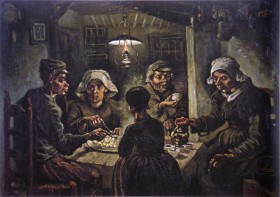
“You see, I really have wanted to make it so that people get the idea that these folk, who are eating their potatoes by the light of their little lamp, have tilled the earth themselves with these hands they are putting in the dish, and so it speaks of manual labor and — that they have thus honestly earned their food. I wanted it to give the idea of a wholly different way of life from ours — civilized people. So I certainly don’t want everyone just to admire it or approve of it without knowing why.” This statement by Vincent van Gogh clarifies his intentions to draw the painting and can’t be interpreted more correctly. To portray this scene he did years of research […]

Read More...

, , , ,

1 Star2 Stars3 Stars4 Stars5 Stars (2 votes, average: 4.50 out of 5)
Loading...

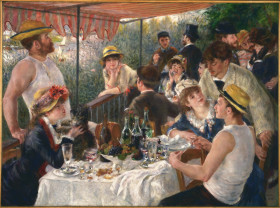
Luncheon of the Boating Party has been one of the known painting by the French artist Renoir born in 19th century. The painting stands as a celebrative depiction a merry company type gathering. Despite being just a regular day, it boasts about goodness of general life. Luncheon of the Boating Party Analysis The depiction is made in the similar strokes of his another painting The Ball at the Moulin de la Galette. Small, light toned strokes for a smooth output. This unique depiction way makes the whole picture a bit blurry as the lines aren’t hard enough in compare to other conventional methods. Subject matter of the painting is apparent. Some people have gathered at a house’s balcony to have some good  time. Total of […]

Read More...

, , , , , ,

1 Star2 Stars3 Stars4 Stars5 Stars (22 votes, average: 4.27 out of 5)
Loading...

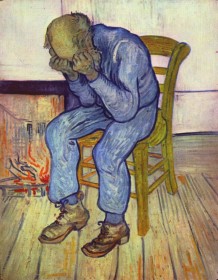
Displaying mental distress with insane feelings of the sorrow, the picture describes an old man crying over for unknown reasons.  He is stressed out and looks unable to bear any more stress as he is trying to hide from the tensed world by concealing his eyes behind his fists. The support by the elbow represents his weakness and inability to cope more with the undesired situations. The strongly closed fist may represent the anger inside him which has aroused after many years of anxiety and strain as those are the essential factors for anger. The flames in the fireplace at backdrop may represent the fiery agony by which the old man is suffering and has become an infinite struggle. Van Gogh firstly made draft of […]

Read More...

, , , , , , , , ,

1 Star2 Stars3 Stars4 Stars5 Stars (3 votes, average: 3.33 out of 5)
Loading...

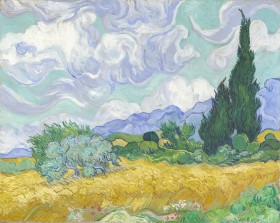
This painting is a part of the series Cypresses by Van Gogh produced in 1889-1890. The represented one is the most popular as it got famed in 1993 after its sell to Walter H. Annenberg for an equivalent amount of $ 86.3 million. It is considered as the artist one of the masterpieces. Though, if one takes a closer look at the painting, he learns that the depiction is more related to his fantasy than the reality as if he just watched the real scene and then depicted it in his own style of broken brush and post-impressionist vivid colors. This portrayal from his last days has filled with vibrant and close to original colors as he accepted the post-impressionism. Van Gogh’s prominent works has […]

Read More...

, , , , , , ,

1 Star2 Stars3 Stars4 Stars5 Stars (13 votes, average: 4.15 out of 5)
Loading...

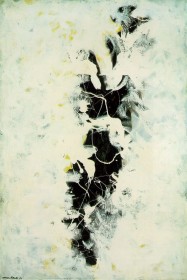
Jackson Pollock’s Drip paintings became known to the world from 1940s and 1950s when his star was the brightest in his whole career. The American artist’s whole career was based on newly invented technique which is sometimes described as the blend of Abstract Expressionism, Surrealism and Cubism with his own Drip technique. This blend mostly created a joyous creation which would get the viewer’s attention and get them instantly interpreting the work. Pollock’s popular work, No. 5, 1948 (ranking in world’s most expensive paintings sold) is a good example of it. The Deep Analysis The current painting is mostly done with black and white, the essential colors. There are some specks of light blue and yellow, though. Just like Pollock’s other works, it’s huge with […]

Read More...

, ,

1 Star2 Stars3 Stars4 Stars5 Stars (No Ratings Yet)
Loading...

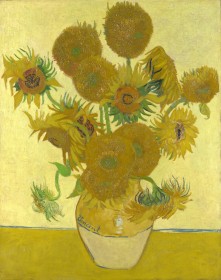
Among the many series of self-portraits, family members, peasants, still-life, cypresses and farmers there, he produced a series of sunflowers proclaiming: “You may know that the peony is Jeannin’s, the hollyhock belongs to Quost, but the sunflower is mine in a way.” The current still-life painting is from the same series being as the forth version of the sunflowers. He painted it while his stay in Arles in 1888 just two years before his death. His fascination towards sunflowers was due to his intention to decorate his house just before his beloved friend Paul Gauguin (the same friend with whom he had the infamous fight) intended to come at his house for some times. There is his signature visible on the left side of the […]

Read More...

, , , , ,

1 Star2 Stars3 Stars4 Stars5 Stars (5 votes, average: 3.20 out of 5)
Loading...

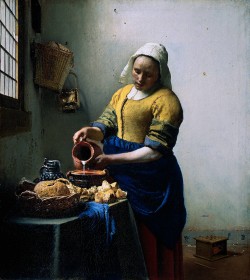
The Milkmaid ranks among Johannes Vermeer’s best known works. It is known for its ample depiction and also for multiple interpretations viewers and critics make, which ranges from pragmatic views to theoretical meanings. The painting origins from the 17th century of Dutch Golden Age. The Subject The subject of the painting is a Milkmaid pouring fresh milk in a bowl. Though, in the 17th century Dutch people didn’t have special Milkmaids. They were called “Kitchen maids” or ‘maid of all works’. Such maids were subject to do all types of works necessary in the kitchen or house. Also, such kitchen maids were also predisposed for love and sex. It wasn’t unapproved in society. The Milkmaid Analysis Vermeer has depicted the scene and the woman with […]

Read More...

, , , , ,

1 Star2 Stars3 Stars4 Stars5 Stars (3 votes, average: 3.67 out of 5)
Loading...

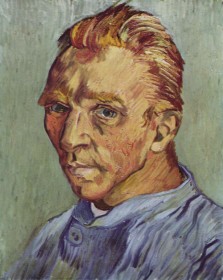
Being in our post of Legend of Vincent van Gogh, the Dutch artist’s this priciest portrait with a huge price tag of $ 71.5 million around 15 years before in 1998 was the third costliest painting of all the time and fourth if we consider the price-inflation. And it is still an impressive rank for a portrait. Alongside with its enormous price-tag there are other facts which make this painting unique from the rest of the self-portraits by Vincent van Gogh which are totals more than 35. This self-portrait executed in 1889, was the last self-portrait by the artist. After that he majorly focused upon the cypresses and wheat fields. Moreover, this is the only painting depicting the artist without beard. As Van Gogh’s many […]

Read More...

, , , , , ,