 (No Ratings Yet)
 Loading...
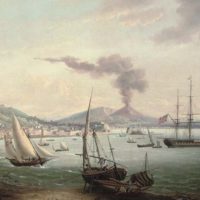 An English Frigate In The Bay Of Naples by John Thomas Serres
 Figures on a beach near Naples by Giovanni Serritelli
 View of Brussels from the NorthEast by Hercules Seghers
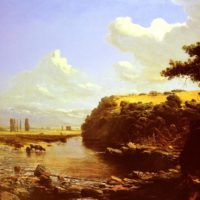 Cattle watering in a River Landscape, believed to be Chile by Thomas Jacques Somerscales
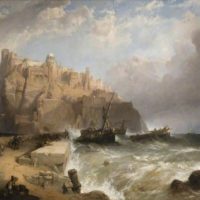 The Castle of Ischia by Clarkson Stanfield
 Landscape with Rocky Hills and Stream by William Louis Sonntag
 Landscape with Waterfall and Figures by William Louis Sonntag
 The Tale Of Kynon by George Sheringham
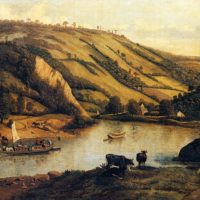 An Extensive River landscape, Probably Derbyshire, With Drovers And Their Cattle In The Foreground by Jan Siberechts
 Landscape with Rainbow, Henley-on-Thames by Jan Siberechts
 (2 votes, average: 4.00 out of 5)Loading...
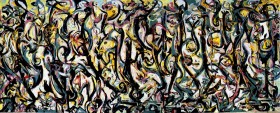
“It’s a stampede… [of] every animal in the American West, cows and horses and antelopes and buffaloes. Everything is charging across that goddamn surface.”These are the words of Jackson Pollock on his piece ‘Mural’ made in 1943. As it came out, most critics adored it and welcomed it with greetings. Some also considered it one of the best productions by the artist. The painting itself is very large being sized of 8 by 20 feet. It was made on the commission given by Peggy Guggenheim. Recommended Books Jackson Pollock’s Mural: The Transitional Moment
 (No Ratings Yet)Loading...
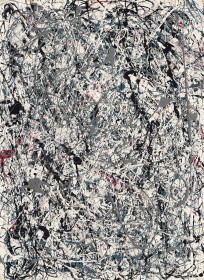
At closer look, Jackson Pollock’s paintings seems to be more of an impasto art-work with its thick colors almost protruding out of the painting and generating shadows near those thick color-lines. It creates a fine surface which becomes a part of the art. Number 19, 1948 is similar painting with thick color implementation. At some places, you can almost see thick droplets. That’s how they are called the Drip paintings of Jackson Pollock. Number 19, 1948 Analysis The Painting is no exception of the drip painting technique. There are maximum 6 colors apparent: ivorish- white as the main background. Over that are the black, grey and bluish green colors. Minorly used colors are red and very tiny specks of yellow at some places which could […]
 (1 votes, average: 5.00 out of 5)Loading...
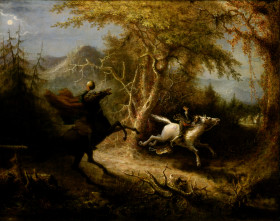
American painter John Quidor has depicted a famous scene from the short story collection The Legend of Sleepy Hollow by Washington Irving. The story is about a girl who is sought by two men. The ill-hearted person doesn’t get the girl at the end and on the return to his hometown, he gets persuaded by a ghost of a headless horseman in the haunted jungle on the road. The painting above is the representation of the moment when the person sees the headless horseman for the first time, gets frightened by the sight and tries to pace away on his horse. The Headless Horseman Pursuing Ichabod Crane Analysis The physical size of the canvas is near to 3 x 2 feet. The large canvas allows […]
 (1 votes, average: 5.00 out of 5)Loading...
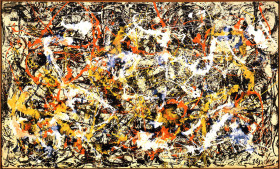
Jackson Pollock’s known Drip painting Convergence holds many shades of colors, different with intensity contrast and depth is an Abstract Expressionist art-work. Unlike his famous works No 5, 1948, Mural or The Deep, this piece holds much more bright and contrasting color making it eye-catching. Jackson Pollock’s most paintings where large at size. This one is no exception. The canvas is the size of around 8 x 13 feet. It takes up a whole wall in the Albright-Knox Art Gallery, Buffalo, N.Y where it currently resides.
 (13 votes, average: 4.15 out of 5)Loading...
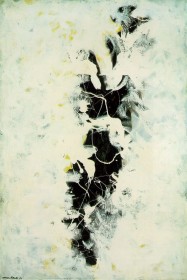
Jackson Pollock’s Drip paintings became known to the world from 1940s and 1950s when his star was the brightest in his whole career. The American artist’s whole career was based on newly invented technique which is sometimes described as the blend of Abstract Expressionism, Surrealism and Cubism with his own Drip technique. This blend mostly created a joyous creation which would get the viewer’s attention and get them instantly interpreting the work. Pollock’s popular work, No. 5, 1948 (ranking in world’s most expensive paintings sold) is a good example of it. The Deep Analysis The current painting is mostly done with black and white, the essential colors. There are some specks of light blue and yellow, though. Just like Pollock’s other works, it’s huge with […]
 (No Ratings Yet)Loading...
Number 11, 1952 is, as the title suggests, a painting made by the American Drip Painting artist Jackson Pollock in 1952. It ranks among one of the most famous works by Pollock. Initially, as the painter prefers, the title of the painting was simply as Number 11, 1952 but later on in 1954, Pollock gave it another name alongside, Blue Poles. Some critics were disgruntled by the name alteration/addition, saying that a verbal name for such drip painting was limiting the viewers’ imagination by forcing them to search for the blue poles. Instead, the numerical names which artist always gave to the public provided the freedom to interpret and understand the art-work according to their temperament. That’s what, as said, was the essence of a […]
 (No Ratings Yet)Loading...
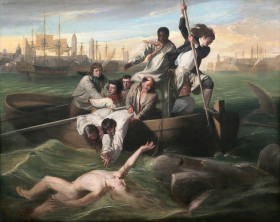
One of the famous American paintings depicting a real life event. When 18th century artist, John Singleton Copley reached in London in 1774, Brook Watson commissioned him to portray his life event when he was attacked by shark during a swim in ocean. The attacked had happened in 1749, when Watson was of 14 years old. Total of three versions were made of the event. Each with slightly different depiction method. The represented one is a romanticized version which hides the cut off leg of Watson in the depth of water. During the attack, shark had bitten off his one leg. As it would be expected for such scenes, everyone on the boat is frightened and is helping to save Watson. Watson was saved eventually […]
 (2 votes, average: 5.00 out of 5)Loading...
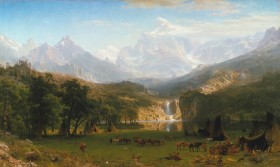
A masterpiece happens when the artist doesn’t miss to include anything in the contexts of logic, theme, aesthetics, subject and reality. Though, that’s not an ultimate definition or the key to create a masterpiece. Those are just the few elements which we see in a masterpiece regardless it is a painting, story, sculpture or a building. They are mostly very comprehensive. The current painting could be categorized as a masterpiece of the artist. Giving enough weight and stance to each object in the painting, he hasn’t missed the littlest details of the real environment. Even a little squirrel on the lower left corner stands there un-boastingly. The painting could be called a veduta. The tribe resting beside the stream is a fortunate one for the […]