
Famous Archive

1 Star2 Stars3 Stars4 Stars5 Stars (22 votes, average: 4.27 out of 5)
Loading...

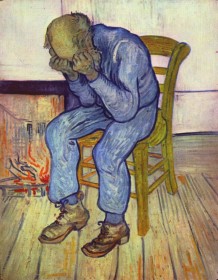
Displaying mental distress with insane feelings of the sorrow, the picture describes an old man crying over for unknown reasons.  He is stressed out and looks unable to bear any more stress as he is trying to hide from the tensed world by concealing his eyes behind his fists. The support by the elbow represents his weakness and inability to cope more with the undesired situations. The strongly closed fist may represent the anger inside him which has aroused after many years of anxiety and strain as those are the essential factors for anger. The flames in the fireplace at backdrop may represent the fiery agony by which the old man is suffering and has become an infinite struggle. Van Gogh firstly made draft of […]
Read More...

, , , , , , , , ,

1 Star2 Stars3 Stars4 Stars5 Stars (3 votes, average: 3.33 out of 5)
Loading...

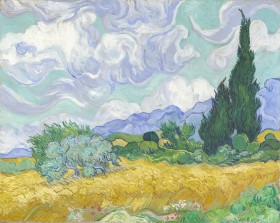
This painting is a part of the series Cypresses by Van Gogh produced in 1889-1890. The represented one is the most popular as it got famed in 1993 after its sell to Walter H. Annenberg for an equivalent amount of $ 86.3 million. It is considered as the artist one of the masterpieces. Though, if one takes a closer look at the painting, he learns that the depiction is more related to his fantasy than the reality as if he just watched the real scene and then depicted it in his own style of broken brush and post-impressionist vivid colors. This portrayal from his last days has filled with vibrant and close to original colors as he accepted the post-impressionism. Van Gogh’s prominent works has […]

Read More...

, , , , , , ,

1 Star2 Stars3 Stars4 Stars5 Stars (No Ratings Yet)
Loading...

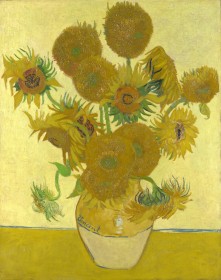
Among the many series of self-portraits, family members, peasants, still-life, cypresses and farmers there, he produced a series of sunflowers proclaiming: “You may know that the peony is Jeannin’s, the hollyhock belongs to Quost, but the sunflower is mine in a way.” The current still-life painting is from the same series being as the forth version of the sunflowers. He painted it while his stay in Arles in 1888 just two years before his death. His fascination towards sunflowers was due to his intention to decorate his house just before his beloved friend Paul Gauguin (the same friend with whom he had the infamous fight) intended to come at his house for some times. There is his signature visible on the left side of the […]

Read More...

, , , , ,

1 Star2 Stars3 Stars4 Stars5 Stars (5 votes, average: 3.20 out of 5)
Loading...

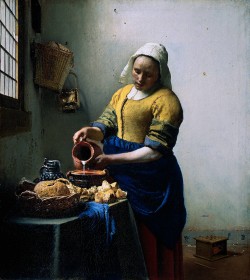
The Milkmaid ranks among Johannes Vermeer’s best known works. It is known for its ample depiction and also for multiple interpretations viewers and critics make, which ranges from pragmatic views to theoretical meanings. The painting origins from the 17th century of Dutch Golden Age. The Subject The subject of the painting is a Milkmaid pouring fresh milk in a bowl. Though, in the 17th century Dutch people didn’t have special Milkmaids. They were called “Kitchen maids” or ‘maid of all works’. Such maids were subject to do all types of works necessary in the kitchen or house. Also, such kitchen maids were also predisposed for love and sex. It wasn’t unapproved in society. The Milkmaid Analysis Vermeer has depicted the scene and the woman with […]

Read More...

, , , , ,

1 Star2 Stars3 Stars4 Stars5 Stars (3 votes, average: 3.67 out of 5)
Loading...

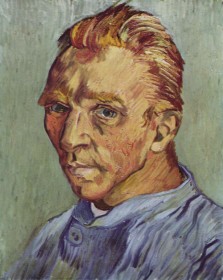
Being in our post of Legend of Vincent van Gogh, the Dutch artist’s this priciest portrait with a huge price tag of $ 71.5 million around 15 years before in 1998 was the third costliest painting of all the time and fourth if we consider the price-inflation. And it is still an impressive rank for a portrait. Alongside with its enormous price-tag there are other facts which make this painting unique from the rest of the self-portraits by Vincent van Gogh which are totals more than 35. This self-portrait executed in 1889, was the last self-portrait by the artist. After that he majorly focused upon the cypresses and wheat fields. Moreover, this is the only painting depicting the artist without beard. As Van Gogh’s many […]

Read More...

, , , , , ,

1 Star2 Stars3 Stars4 Stars5 Stars (3 votes, average: 5.00 out of 5)
Loading...

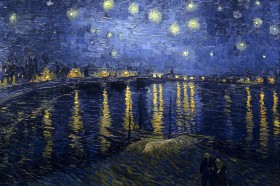
Painting executed in the same city and in the same month, in which the Café Terrace at Night was produced, Starry Night over the Rhone captures a different view and different angle of the beautiful city cited in Paris. Rhone – that which rolls – is an important river running through Arles. Its importance and the beauty at night maybe allured the artist to illustrate it with oil on his canvas. Van Gogh has never tried to depict scene in their natural conditions. He always twisted the scenes and added imaginary colors and portions to the scene to get the exact impact he willed for. Adding artificial color to the image was a new idea in his time and Van Gogh used it very well […]

Read More...

, , , , ,

1 Star2 Stars3 Stars4 Stars5 Stars (3 votes, average: 3.00 out of 5)
Loading...

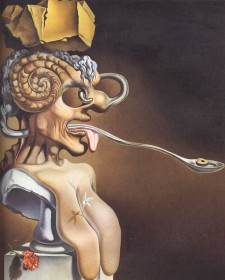
This is an ambivalent painting of cubist artist Pablo Picasso by the surrealist master Salvador Dali produced in the year of 1947. Portrait of Picasso Analysis The surrealist portrait painting of Pablo Picasso by Salvador Dali is infused with symbolic messages and meanings as Dali’s most famous works are. Basically, instead of a direct face, it is a portrait of Picasso’s bust sculpture. The base of the bust is made out of the regular white stone out of which most bust-sculptures are made of. But, the upper part is covered with skin. There is a white flower in the distorted chest of the bust, while a red one, is laying at the feet of the bust. The head is much more distorted than the chest […]

Read More...

, , , , , , ,

1 Star2 Stars3 Stars4 Stars5 Stars (1 votes, average: 3.00 out of 5)
Loading...

Van Gogh’s one of the last paintings, Bedroom in Arles depicts his trapezoid shaped room of his Yellow House which he rented for some time during his stay in Arles. He sent his paintings to his brother Theo from time to time just for a general review about them. He made total of three version of the same painting. The first one was just a depiction of his room while the necessity of the second version aroused due to the damage by the flood of the Rhone. His brother suggested him to draw another version. Thus the second version emerged in September 1889. The last version simply called as The Bedroom was executed in smaller size than the original calling it the reduction. Three of […]

Read More...

, , , , ,

1 Star2 Stars3 Stars4 Stars5 Stars (No Ratings Yet)
Loading...

Number 11, 1952 is, as the title suggests, a painting made by the American Drip Painting artist Jackson Pollock in 1952. It ranks among one of the most famous works by Pollock. Initially, as the painter prefers, the title of the painting was simply as Number 11, 1952 but later on in 1954, Pollock gave it another name alongside, Blue Poles. Some critics were disgruntled by the name alteration/addition, saying that a verbal name for such drip painting was limiting the viewers’ imagination by forcing them to search for the blue poles. Instead, the numerical names which artist always gave to the public provided the freedom to interpret and understand the art-work according to their temperament. That’s what, as said, was the essence of a […]

Read More...

, , , ,

1 Star2 Stars3 Stars4 Stars5 Stars (1 votes, average: 4.00 out of 5)
Loading...

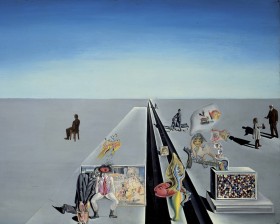
This is one of the earliest surrealist paintings from Salvador Dali. It was produced in 1929 when Dali was around 25 years old. He had completed his short experiments with Cubism and was getting allured towards the Surrealism which he expanded largely in his later life. The First Days of Spring Analysis There is a large, endless grey platform spreading on all sides visible in the scene. In the middle, the platform lowers itself two steps on the left side. Normal, natural, abnormal, unnatural, dreamy…all types of elements are put on this big plain in arbitrary manner. Some resembles to the real life natural objects, on the other some are very bizarre and somewhat nightmarish. For example, a feminine figure sitting on the lower left […]

Read More...

, , , , , ,