 (No Ratings Yet)
 Loading...
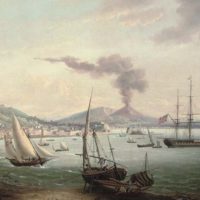 An English Frigate In The Bay Of Naples by John Thomas Serres
 Figures on a beach near Naples by Giovanni Serritelli
 View of Brussels from the NorthEast by Hercules Seghers
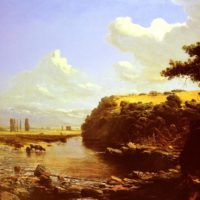 Cattle watering in a River Landscape, believed to be Chile by Thomas Jacques Somerscales
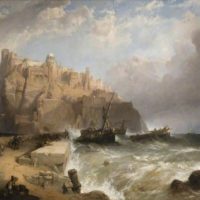 The Castle of Ischia by Clarkson Stanfield
 Landscape with Rocky Hills and Stream by William Louis Sonntag
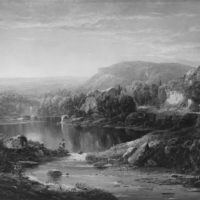 Landscape with Waterfall and Figures by William Louis Sonntag
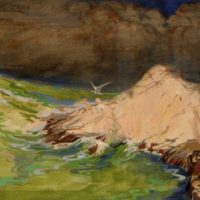 The Tale Of Kynon by George Sheringham
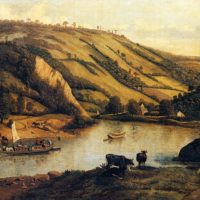 An Extensive River landscape, Probably Derbyshire, With Drovers And Their Cattle In The Foreground by Jan Siberechts
 Landscape with Rainbow, Henley-on-Thames by Jan Siberechts
 (1 votes, average: 4.00 out of 5)Loading...
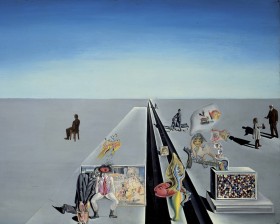
This is one of the earliest surrealist paintings from Salvador Dali. It was produced in 1929 when Dali was around 25 years old. He had completed his short experiments with Cubism and was getting allured towards the Surrealism which he expanded largely in his later life. The First Days of Spring Analysis There is a large, endless grey platform spreading on all sides visible in the scene. In the middle, the platform lowers itself two steps on the left side. Normal, natural, abnormal, unnatural, dreamy…all types of elements are put on this big plain in arbitrary manner. Some resembles to the real life natural objects, on the other some are very bizarre and somewhat nightmarish. For example, a feminine figure sitting on the lower left […]
 (No Ratings Yet)Loading...
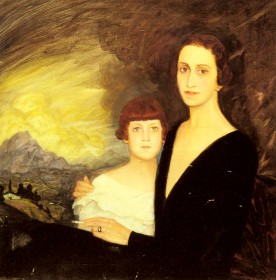
Ramon de Zubiaurre lived through a period marred by two wars, the sinister advent of global credit systems and ideologies that required the breaking of families. However, the two world wars in de Zeubiaurre’s lifetime are telling enough about what moods his paintings would evoke. Although it is not sorrow that flows out of it, you can see a depiction of negative social changes in all his works – even if he did not paint a perfectly-normal-looking-mother-daughter portrait, in which the mother’s cigarette and plunging neckline would evoke questions. While today we see strong advices against tobacco smoking, it was no different, at least for women, it times that preceded Ramon de Zubiaurre’s career. The painter died in 1969, before which he saw a change […]
 (No Ratings Yet)Loading...
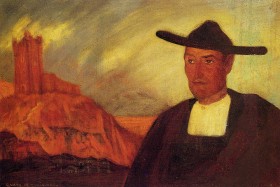
Hombre de Fuensaldana by Ramon de Zubiaurre is one of the social-relevance type paintings, with focus on the individual – rather than society. However, the importance of the individual’s location is paramount, as I guessed it would be when I was about to enter the de Zubiaurre special features gallery. At the same time, I should admit that there is not a world of difference between this one and the other works, although it seems the Spanish painter did not put in an effort to glorify the man or his story with the brush strokes. It seems that the subject has a degree of attachment to the nobility – or maybe he is a learned man who seeks such an attachment. The castle is big […]
 (9 votes, average: 4.22 out of 5)Loading...
Le Reve (“Dream” in French) is Pablo Picasso‘s most famous, expensive and also controversial painting of all the time. The highly contrasting colors and the overly simplified depiction is from Picasso’s period of distorted depictions. He had various periods of different types of depictions in his art during his lifetime. This style is said to be near style of Fauvism, which also used contrasting colors. A little controversy attached to this piece of art is that Picasso has depicted an erect penis over the face of the woman, which is not official but many critics believe it to be portrayal of his own. Artists do include hidden messages, ideas or designs in their paintings often and the apparent resemblance of the painting is provoking the critics […]