Portrait Painting Archive
Among the different types of paintings, Portrait Paintings are comprehensive ways to capture a man’s glory, disposition or social stance in one single moment. It is a style which quickly captures the viewer’s attention and gives a quick glimpse in the past of the depicted person or group. Portrait paintings stand strong among the other types of paintings.
Definition of Portrait
According to Oxford Dictionary, “A painting, drawing, photograph, or engraving of a person, especially one depicting only the face or head and shoulders.”
Though, the last words of the definition aren’t the mandatory properties of a portrait as the type has grown into much more complex and various ways of depicting a person.
Comprehensive Depiction
Portraits could represent a person, an artist or a group of people. They are just the simple depictions of people. Still, they aren’t just profiles of the persons. Sometimes, portraits could tell us more history about the contemporary times than a city’s landscape from the same era.
For instance, during the Dutch Golden age, people were afraid of expressing their pride through an extravagant portrait as it was considered bad during the time. Thus, the total of more than 1 million portraits from that time were mostly dull, expressionless and similar. You won’t get this information in the brilliant vista of a cityscape.
Even the most famous painting in the world is also a portrait. Other famous paintings like Girl with a Pearl Earring and American Gothic are also different types of portrait as you would know about them in detail at here.
Artists would generally have very limited space to include any significant object in the portrait as compared to a Landscape Painting or a Still Life Painting where he can add all the objects he could imagine. Thus, the included objects, scenes, background or other elements would be chosen very carefully to represent the accurate impression of the person or persons portrayed. Artist would care of the littlest details to represent the disposition or the concurrent impression of the person and would eliminate any redundant objects or implications. It is somewhat similar to still-life in which every included element generally holds some meaningful symbolism.
Thus, portraits could embody the person’s disposition, general impression, importance, significance, background, stance in society, history, a specific phase or the whole society’s outlook through a single representative person.
Types of Portraits
According to the subject, context or need of the artist, portrait paintings have developed many types to distinguish or signify different characteristics. Each type has been developed over the different centuries or ages and have matured in today’s portraits. This, findings and techniques of portrait paintings have significantly helped the portrait photography in modern times. You can find a mode called “portrait” in your phone’s camera. The term is derived from here, obviously.
If you haven’t read our post on the Different Types of Portraits, you can read about it on the given link.

Loading...
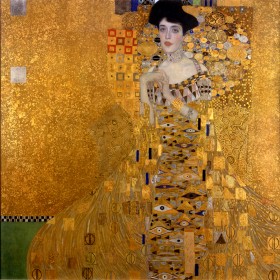
Referred sometimes as the Austrian Mona Lisa, “Portrait of Adele Bloch-Bauer I” by Gustav Klimt is a world-known portrait of a wealthy society aristocrat woman named Adele Bloch- Bauer. The whole painting is depicted with real gold and silver leaves, and some regular oil paint. There was also another portrait of the woman called Adele Bloch Baucer II. The Painting made the Austrian artist so famous and main stream, that after the exhibition of the work, he got many commissions. The painting was from his golden age during which he worked with real gold and silver for his paintings. This wasn’t his first time use of paintings. Painting broke all records of being expensive in June 2006 by a staggering amount of $135 million paid by […]
Read More...
Aristocrat, Austrian, Austrian Woman, Expensive, Famous, Gold, Stolen, Three Quarter Length Portrait
Loading...
Le Reve (“Dream” in French) is Pablo Picasso‘s most famous, expensive and also controversial painting of all the time. The highly contrasting colors and the overly simplified depiction is from Picasso’s period of distorted depictions. He had various periods of different types of depictions in his art during his lifetime. This style is said to be near style of Fauvism, which also used contrasting colors. A little controversy attached to this piece of art is that Picasso has depicted an erect penis over the face of the woman, which is not official but many critics believe it to be portrayal of his own. Artists do include hidden messages, ideas or designs in their paintings often and the apparent resemblance of the painting is provoking the critics […]
Read More...
Expensive, Famous, Picasso's Distorted Depictions Period, Reverie, Spanish, Spanish Girl
Loading...
William Frost, an English painter from Victorian era, has depicted the mythological figure of Terpischore in the current portrayal. In Greek mythology, Terpischore is one of the nine Muses who are the goddesses of literation, science and arts with different departments allocated to each of them. Terpischore possess the knowledge of dance and dramatic chorus. Even the meaning of her name is “delight in dancing” and her emblem is a lyre. William Frost has represented the same figure in a different angle of sensuality and love in this oil-on-paper painting. The heart-shaped emblem which she seems to playing with her fingers is the symbol of the intimacy she desires to have. The shy face with downward eyes consist the feminine demure. It is very poetic […]
Read More...
British, Dance, English, Goddess, Greek, Greek Mythology, Lyre, Mythology, Nude Lady, Victorian Era
Loading...
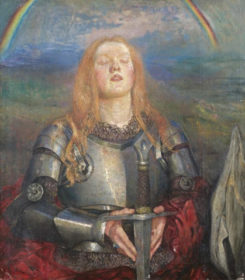
Annie Swynnerton is a well-remembered name among art lovers irrespective of their backgrounds. Whether you are rich, poor, industrious, lazy, Socialist or a right wing, appreciating the suffragette’s works is unavoidable because they make the presence of character and individual strength quite evident despite your possible willingness to accept that Swynnerton may have renounced God. While Joan of Arc believed in God to an extent Swynnerton may have found ridiculous or even laughable, the fact remains that Swynnerton’s works has seen the addition of a new character in the old line up of inspiring women. Remember that in other works, where she has painted male portraits, the subjects are either too old or too young to fit the description of the classical hero that pervaded the Renaissance art movements. Annie Swynnerton seems to be more leniently […]
Read More...
Armor, Folklore, French, Joan of Arc, Knight, Martyr, Rainbow, Roman, Sword
Loading...
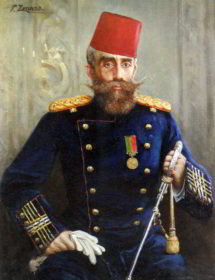
If you are aware of the political games played across portals of power, you may not find too hard to believe that the Bolsheviks were encouraged to make their aggression against Eurasian monarchies by many western minds to gain some sort of control over the region. One of the heroes resisting the rebellious movement was Mahmud Sevket Pasha of Turkey. It raged fiercely in the political arena by the end of 1909, as the rebels were demanding an overthrow of the constitutional monarchy in the Ottoman region. By the time it had gained enough fanning to get violent and conspiratorial, the Pasha was able to subdue the forces adequately, to the effect that it brought an end to the movement and the probable mayhem. However, […]
Read More...
Army General, Military Uniform, Ottoman, Ottoman Army, Ottoman Soldier, Realist, Sword, Turkish
Loading...
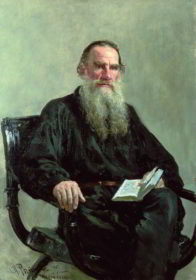
Title of the painting represents two greatest artists from Russia. One is Ilya Repin himself and another is Leo Tolstoy, who doesn’t need any introduction. They both were ample artists and Ilya Repin is said to enjoy a respect in his art similar to Leo Tolstoy enjoyed in his literature. The convergence of these two big figures in one art-work is enough to make the art-work utterly important. Ilya Repin painted many portraits of Leo Tolstoy after they befriend in 1878. Leo Tolstoy Ploughing, Leo Tolstoy Barefoot and a pencil work called Leo Tolstoy Reading are the three works associated to Leo Tolstoy other than the current picture. Ilya Repin painted this portrait of Leo Tolstoy in 1887 with oil on canvas. It represents the […]
Read More...
Artist, Beard, Book, Individual Portrait, Leo Tolstoy, Reading, Russian, Writer
Loading...
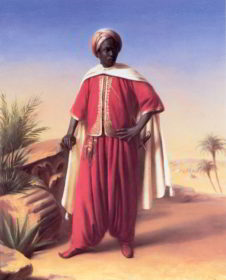
In his time, painter of the “Portrait of an Arab”, Horace Vernet didn’t need an introduction, as he worked for the contemporary King Louis-Philippe and Napoléon III of France. Though, he is still remembered with an honor in art-communities. In early 19th century, he was renowned for his great artworks like Dog of the Regiment, Death of Poniatowski and Battle of Montmirail. His fields of interests varied only between portraits, Arabians and battles. And he didn’t want to paint in the traditional ways. He had grown a particular disinclination with traditional idealized ways of paintings. He wanted to draw things with more general touch and feel, instead of giving his subjects an idealized pose; he created his paintings with more vernacular manner. Thus, the viewer […]
Read More...
Arab, Arabian, Black Man, Desert, Man, Turban
Loading...
With sharp details and acute description, in “An Egyptian Beauty”, English painter William Wontner has portrayal a vivid depiction of an ancient Egyptian woman with contemporary attire. The rich attire, ornaments and the surrounding of a room (from a palace probably) shows her as a woman from an aristocrat or royal family. Painter has depicted her in such a grace and feminine posture that any person would immediately fall in love with her. The perfect clothing and the details of the clothes are astonishing. Look closely at the dual colored waist-cloth. That’s something really hard to achieve with oil on canvas. It seems deliberate choosing bright and attractive colors to gain instant attention at the lady. The title says the woman is from the Egyptian […]
Read More...
Aristocrat, Beautiful Woman, Egyptian Beauty, Egyptian Lady, Royal
Loading...
The well-known Russian composer, Mikhail Glinka lived in early 19th century is thinking a composition for the celebrated Russia Opera Ruslan and Lyudmila (his second best known opera after “A Life of the Tsar”) which was based on the epic fairy tale poem by Alexander Pushkin. He was an influential composer in Russian music and led the famous band called “The Five” creating new music styles. Ilya Repin’s depiction of this legendary man shows him in a royal manner. He has calm, deep and tranquil expressions on his face as if have indulged in the thoughts to create a good music piece for the fairy tale opera. The opera was parted in six songs. Although, the writer of the fairy tale was drunk at the […]
Read More...
Artist, Man, Mikhail Glinka, Realist, Russian, Thinking Man
Loading...
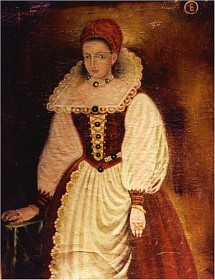
The represented painting is the only picture of Elizabeth Bathory – the countess of Transylvania depicted in the late 16th century by an artist whose identification is not available today. Elizabeth Bathory has a notable legacy. She has left for us a life which is unbelievable, grotesque and to some extent makes us hate Vampires even more (not the phony vampire’s depicted in today’s novels, I won’t even consider them as genuine vampires.) According to modern researchers, she was a victim of Sadism – A mental disorder in which a person tries to gain pleasure (not happiness) through torturing others – humiliation, molesting, sexual abuse, excessive torturing, cutting body parts and murders. The range of the ways to gain pleasure for a sadistic person is […]
Read More...
Aristocrat, Coutness, Hungarian, Woman