Hierarchy Archive

Loading...
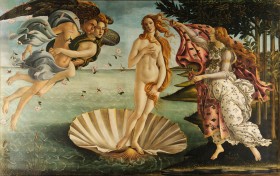
The Birth of Venus is equally famous work of Sandro Botticelli with Primavera. It simply depicts the moment of the birth of the love-goddess Venus in renaissance era style. It holds a much lesser approach of the renaissance era’s masculine and somewhat three-dimensional depictions. The painting seems more linear and flat in comparison to the other famous works from the same era. In Roman mythology Venus (Aphrodite in Greek mythology) is the goddess of divine love, sex, beauty, seduction and all the persuasive feminine aspects. She symbolizes the intellectual and physical love, attractions. Sometimes she is referred as the heavenly goddess of intellectual love and at many places she is said to be the earthly goddess of physical love or sex. Myth of Birth of […]
Read More...
Angel, Birth, Contrapposto, Famous, Flower, Goddess, Greek Mythology, Nude Lady, Nymph, Roman Mythology, Sea, Sea Shore, Seashells, Venus
Loading...
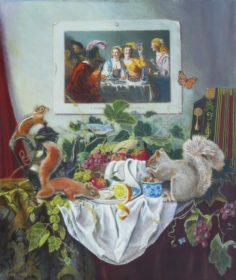
Unlike the title sounds, to me there seems to be a lot of family value attached to this painting. George Hartley lived and thrived amidst 19th Century art, allowing his growth to remain unhindered as an aspiring artist. He has earned much name as a painter of real life situations and more importantly, as a realist. Party Animals is not just about partying, as we would think today. It is a rich ensemble of cultural celebration, personal ties and happy or affluent times. Hartley drew inspiration not only from realism in history, but also the fine sculptures, classical perfection and the romantics. However, Hartley is quite popular as the realist who uses shades of grey in a self-realization way. He is hardly the artist you […]
Read More...
American, Animal, Beautiful, Butterfly, Fruit, Grapes, Leaf, Party, Photo, Realist, Squirrel
Loading...
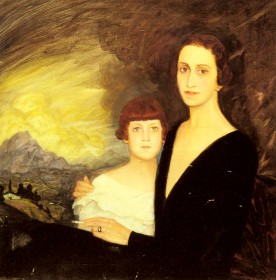
Ramon de Zubiaurre lived through a period marred by two wars, the sinister advent of global credit systems and ideologies that required the breaking of families. However, the two world wars in de Zeubiaurre’s lifetime are telling enough about what moods his paintings would evoke. Although it is not sorrow that flows out of it, you can see a depiction of negative social changes in all his works – even if he did not paint a perfectly-normal-looking-mother-daughter portrait, in which the mother’s cigarette and plunging neckline would evoke questions. While today we see strong advices against tobacco smoking, it was no different, at least for women, it times that preceded Ramon de Zubiaurre’s career. The painter died in 1969, before which he saw a change […]
Read More...
Daughter, Double Portrait, Half Length Portrait, Mother, Motherhood, Spanish, Spanish Woman
Loading...
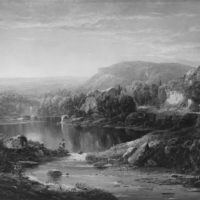
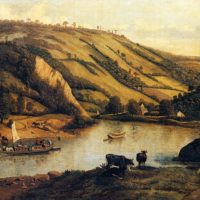
The landscape’s grandeur of “In The Higher Elevations” stuns us when we find out the little man standing middle of the river and also his relative height to the tall trees on the side and the mountain itself. Joseph McGurl has brought out the grandeur of the nature in the current painting with emphasizing on the beauty of the scene. As much as serenity the scene reflects, there also happens to be almost hearing the silent sound of nature in the air over the river. A sound of originality and authenticity. The raw form of nature where standing one alone man feels to be very tiny in front of everything. Painting analysis: Realism, Luminism, En Plein air and Staffage Joseph McGurl is a realist artist […]
Read More...
En Plein Air, Hill, Luminist, Mountain, Realist, River, Staffage
Loading...
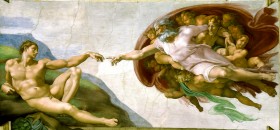
The Creation of Adam is a part of the Sistine Chapel ceiling fresco created by Michelangelo. It is the most famous part of the whole ceiling. The depiction represents God accompanied by angles giving the ‘touch of life’ to Adam. It is a visual representation of the event from the Book of Genesis when on the sixth day, god created Adam, eve and other flora and fauna. Story of Creation of Adam and Eve According to the Book of Genesis (the first book of the Hebrew Bible), God first created Adam on the sixth day. He put him in the Garden of Eden and went away to create other things like animals, trees, rivers, etc. (including trees of knowledge and life). Then after he brought […]
Read More...
Adam, Angel, Biblical, Famous, God, Iconic, Italian, Mythology, Nude Man, Sistine Chapel Ceiling
Loading...
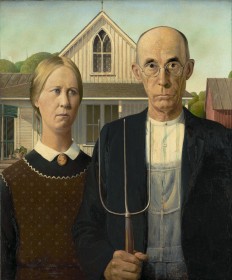
Two simple American faces, one staring at us and another staring away blankly. A pitchfork in the man’s hand and an American Gothic house in the background. These simple things have made the picture so popular that it has appeared in almost all kind of media in modern times. From the Simpsons to The Rocky Horror Picture Show and from the every magazine (such as Time) to big movies, the painting has appeared, parodied, copied numerous times. Today it enjoys the similar popularity gained by other iconic paintings like The Scream by Edvard Munch and Mona Lisa by Leonardo da Vinci. The gloomy faces of the couple may have indicated them as being a couple in their old times and having not-so-well life. But, an […]
Read More...
American, Americana, Daughter, Double Portrait, Famous, Father, Half Length Portrait, Iconic
Loading...
Sometimes referred also as Barbara Dmitrievna Mergassov Rimsky-Korsakova, the “Madame Barbe de Rimsky Korsakov” is a portrait of Russian aristocrat woman. It was painted in 1864 by the German painter Franz Xaver Winterhalter. Identity of the Woman At some places, it is suggested that the woman is the same person who married to the famous Russian music composer Nikolai Rimsky-Korsakov due to the same endings of the name and the same time-period of their births. But, there is no full evidence about it as some important sources suggests Nadezhda Rimskaya-Korsakova to be the composer’s wife. Other speculations are that she also appeared in Russian writer Leo Tolstoy’s classic novel Anna Karenina. But, the identity of the portrayed woman isn’t firmly definite. Art analysis The portrait […]
Read More...
Aristocrat, Beautiful, Beautiful Woman, Russian, Russian Woman, Three Quarter Length Portrait
Loading...
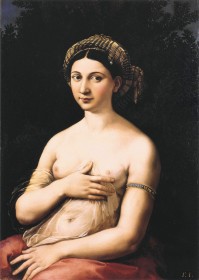
La fornarina was a skillful depiction by high-renaissance artist Raphael. It resembles with Leonardo’s Mona Lisa in terms of the posture, use of the model and the alleged idea behind the portrait. It also includes some elements of popular painting style Chiaroscuro which Raphael borrowed from Caravaggio. La Fornarina, Raphael’s Mistress It is said that the model seated for the portrait was Raphael’s real life model called Margarita Luti. The title of the painting means “the baker’s daughter”. According to Giorgio Vasari, the renaissance period art historian, Raphael was “a very amorous man’ and often looking for ‘amorous pleasures’. Allegedly, during his life he had many mistresses one after another, including daughters of his patrons. Margarita Luti appeared in Raphael’s another portrait La Velata as […]
Read More...
Beautiful, Beautiful Woman, Chiaroscuro, Famous, Italian, Italian Woman, Mistress, Nude Woman, Roman Woman, Sexy Woman, Symbolism, Three Quarter Length Portrait, Three Quarter View Portrait
Loading...
Peter Paul Rubens, the 17th century Flemish Baroque painter painted the first version of the biblical subject Massacre of the Innocents in 1612. It took him two years to finish the painting. It showcases the intense scene of King Herod’s (Herod the Great) soldiers killing the infants of Bethlehem during his reign. Massacre of the Innocents The subject of the painting is the intense massacre of the infants during the time of Herod the Great who after a prophecy, got furious that a Jew boy (Jesus) would uproot his grand reign. After getting outwitted by the Magi, and not knowing which baby would be the reason of his diminishing reign, in fury, he ordered to kill all the infants under age of two. It was […]
Read More...
Biblical, Children, Expensive, Famous, Flemish Baroque, Infants, Innocent, Massacre, Mother, Motherhood, Nude, Soldier
Loading...
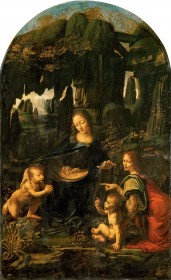
Leonardo executed very few works during his lifetime compared to other renaissance artists. A major reason is that, he was involved in way too much other works associated with science of human anatomy, botany, physics, armory, architecture and many others. But, on the other hand, his deep research and observation in each field helped him between his various fields at some points. The field of painting includes almost everything the nature has to offer and Leonardo just observed everything from fossils, mountains to the moon. Deriving information and hidden facts (for his time) from sources, mostly his every painting came out as a masterpiece from the artistic view point. His every new composition, color, style and new techniques were followed by the Leonardeschi. Sfumato After […]
Read More...
Angel, Children, Famous, High Renaissance, Italian, Madonna, Madonna and Child, Rock, Sfumato, Virgin




 (4 votes, average: 4.00 out of 5)